


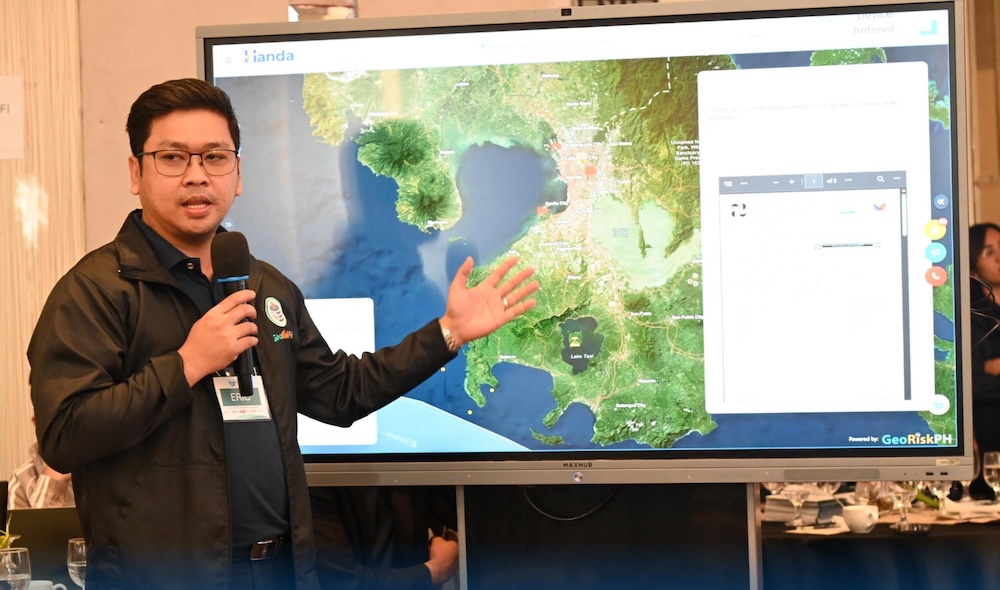
The Philippine Institute of Volcanology and Seismology (PHIVOLCS) has launched HANDA, a unified platform designed to improve early warning, disaster preparedness, and emergency response across the Philippines.
Handa: The Integrated Platform for Preparedness, Early Warning, and Response aims to bring together data, analytics, and coordination tools into a single system powered by geospatial technology and artificial intelligence (AI). It aims to address gaps in how agencies share information and respond to disasters.
Developed under the Geospatial Analytics and Technology Solutions (GATES) Program, HANDA aims to become the country’s national platform for Disaster Risk Reduction and Climate Change Adaptation (DRR–CCA). PHIVOLCS said the system is designed to strengthen coordination among agencies, improve planning, and boost public awareness to help communities better prepare for hazards.
“While the platform may be new, the work behind it is not,” said DOST Secretary Renato Solidum. “What we are doing now is bringing it all together, into a single, accessible, and actionable platform, A one-stop source of truth for our communities, our local governments, and all sectors. After all, we also advocate that information is a basic need.”
HANDA is powered by GeoRiskPH, integrating data and tools into one platform that supports decision-making before, during, and after disasters. It combines near real-time monitoring, location-based alerts, and interactive dashboards that visualize risks from earthquakes, volcanoes, and weather-related hazards.
The platform pulls advisories and warnings from key government agencies, including Department of Science and Technology-PHIVOLCS, Philippine Atmospheric, Geophysical and Astronomical Services Administration (PAG-ASA), and Mines and Geosciences Bureau. This allows local governments and national agencies to access consolidated, up-to-date information in one place.
For decision-makers such as local government units (LGUs) and national government agencies (NGAs), HANDA provides dashboards with analytics, disaster tracking, and impact assessment tools. These features are intended to support faster and more informed responses during emergencies.
The platform also encourages public participation. Citizens can report incidents such as flooding, fires, or road accidents in real time, helping authorities respond more quickly. An Emergency SOS feature allows users to share their location with responders during urgent situations, while an AI-powered chatbot provides hazard updates, weather information, and safety guidance.
HANDA also supports directives from the National Disaster Risk Reduction and Management Council, which tasked the Department of Science and Technology (DOST) to integrate existing disaster-related platforms into a single system.
As lead developer, DOST-PHIVOLCS worked with multiple agencies, including the Office of Civil Defense, PAGASA, the Mines and Geosciences Bureau, the Department of the Interior and Local Government, the Department of Health, the Department of Social Welfare and Development, and the Department of Public Works and Highways. The system consolidates earlier platforms such as HazardHunterPH, GeoAnalyticsPH, GeoMapperPH, and the El Niño Online Platform, along with concepts from PlanSmart.
