


A Filipino scientist is urging wider use of simple building designs that keep homes and buildings cooler without relying heavily on air-conditioning, saying these methods could help reduce electricity use in the Philippines.
Academician Filemon Uriarte Jr. of the National Academy of Science and Technology Philippines said passive cooling strategies could help ease rising energy demand, especially during the country’s hot and dry seasons.
His study, “Passive Cooling Strategies for Sustainable Development,” looks at ways buildings can stay cooler using design and natural airflow instead of mechanical cooling systems like air conditioners.
The approach was tested in Cambodia under a project supported by the United Nations Economic and Social Commission for Asia and the Pacific. In that pilot, cooling was found to account for about 45 percent of electricity use, showing how big a role air-conditioning plays in warm climates.
Uriarte said the project involved an investment of nearly $1 million and focused on whether simple design changes could reduce energy use in homes.
“We just completed a technical review of an almost a million-dollar project implemented by UN ESCAP on passive cooling strategies in Cambodia,” he said. “We recommended that this be replicated in Southeast Asia, including the Philippines, because this area is still not fully developed in terms of passive cooling.”
Passive cooling works by reducing heat inside buildings instead of removing it later with electricity. It can include reflective roof coatings, shaded windows, better airflow design, and strategic use of trees and vegetation around buildings.
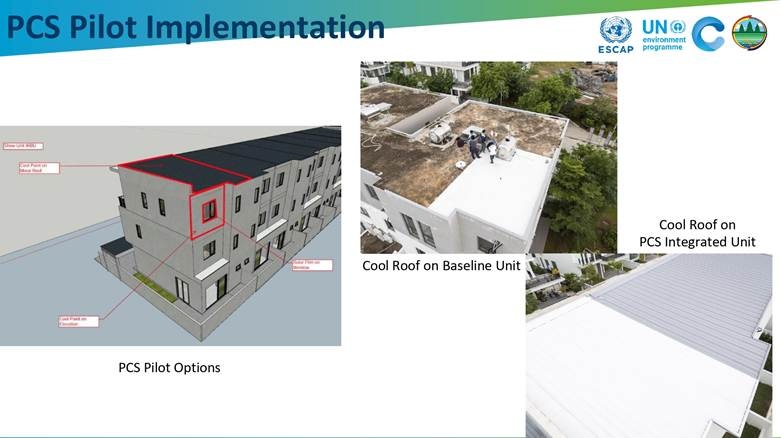
In the Cambodia pilot project, researchers tested several practical solutions in a residential building. These included heat-reflective roof coatings, special low-heat paint, solar film on windows, and outdoor blinds to block sunlight.
The results showed that using these methods more widely could reduce electricity use for cooling by about 20 percent by 2030 to 2040 compared with current trends.
The study also estimated that cooling-related emissions could drop by at least 17 percent if adopted on a large scale. Over time, it could also prevent nearly 3 million tons of carbon dioxide emissions by 2035, equal to emissions from hundreds of thousands of cars.
Uriarte said the findings show that small design changes can add up when applied to many buildings.
“When we evaluated the project, we found it effective in reducing energy consumption and meeting its goals,” he said. “We recommended expanding it to countries like the Philippines.”
He added that passive cooling can also include simple planning choices, such as placing trees and greenery in ways that guide wind flow and reduce heat buildup around homes.
“There are many strategies to maximize passive cooling,” he said. “For example, vegetation can be designed to redirect airflow depending on the site.”
Uriarte presented the study during the Luzon Regional Scientific Meeting organized by the Department of Science and Technology and NAST PHL. The meeting gathered scientists and policymakers to discuss practical solutions to climate and energy challenges.
He said the goal is to encourage more local use of these low-cost cooling methods as electricity demand continues to rise due to hotter weather and increasing air-conditioning use.
