


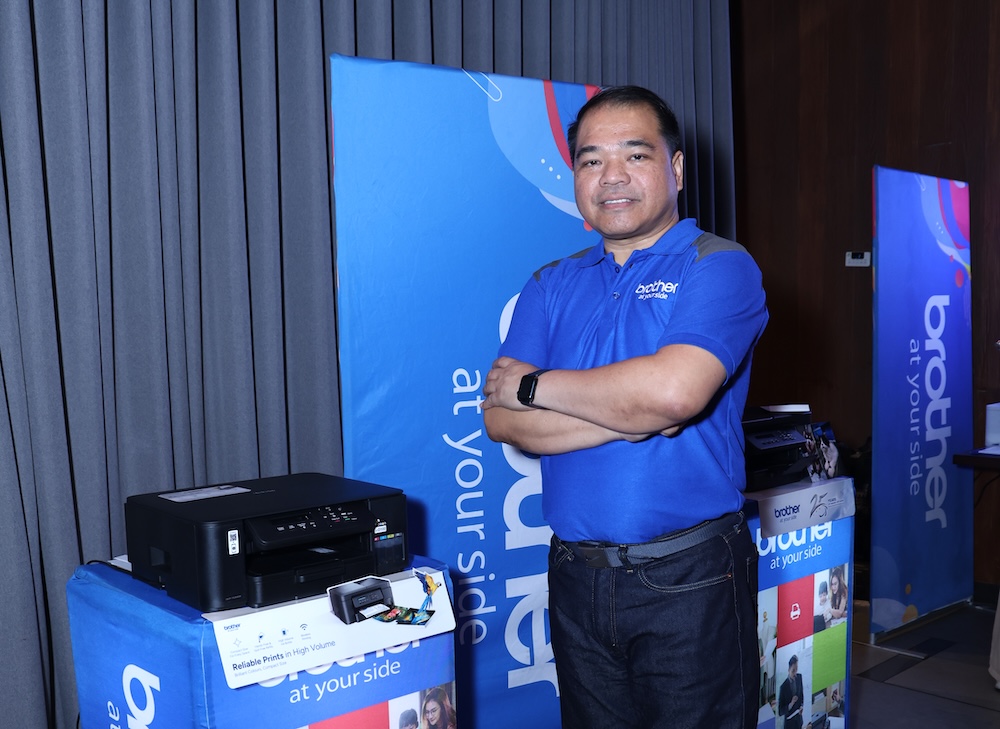
When Brother Philippines entered the country 25 years ago, it was already behind.
Competitors had secured retail space and branding that the market associated with a “steady foundation,” recalled Glenn Hocson, the first Filipino president of Brother PH. “And, we were just starting.”
The brand itself was unfamiliar. In its early years, Hocson said, some customers even confused the name with unrelated local businesses. What changed that was not a single turning point, but a series of early bets on retail partners willing to carry the brand, and distributors who helped bring it beyond Metro Manila.
From there, the company expanded deliberately. It opened branches across the country, from Cebu and Davao to Pampanga and Tuguegarao, and built a network that now includes more than 250 authorized service centers.
“If there is no presence, how can the customer believe in the brand?” Hocson said.
Supporting small business journeys
Brother Philippines found its footing by focusing on small and medium-sized businesses rather than the mass consumer market.
The space was less crowded, but more demanding. Businesses needed machines that could handle volume and support when those machines failed. That need shaped the company’s approach early on. Its printers became fixtures in offices, print shops, and computer rental businesses. At the same time, its embroidery and craft machines opened up opportunities for entrepreneurs, producing all kinds of uniforms and customized goods.
Training programs were designed to help users turn equipment into a source of income. For some, that meant expanding from basic garment work into full-scale customization services. Programs such as the PR Machine Embroidery Caravan provided seminars and hands-on guidance to help aspiring entrepreneurs enter the custom embroidery business.
Newer tools have reinforced that direction. Sublimation printers and cutting machines are now used together by small businesses and hobbyists to produce items like shirts, packaging, and promotional materials. The company has also introduced contract-based models for larger clients, where businesses pay based on usage instead of purchasing machines outright.
Reliability, service, and long-term ties
At the roundtable, a customer described running tens of thousands of prints a day on a Brother machine. The question was direct: why do they last?
Hocson pointed to something less visible than hardware specs. Product decisions, he said, are shaped by constant feedback from users. Even small changes reflect that. Years ago, the company moved away from glossy finishes on its printers to avoid unnecessary materials and focus on durability.
More recent improvements have focused on usability. Ink systems have been redesigned to reduce mistakes, with bottle nozzles that match specific tanks to prevent incorrect refilling. The goal is to make machines easier to use, especially for non-technical users.
But durability alone is not enough. Brother has built out after-sales support as part of its core strategy. With hundreds of service centers nationwide and multiple regional branches, the company aims to ensure that when machines break down, as all electronics eventually do, help is nearby.
That support network has helped build long-term relationships. Some partners have been with the company since the early 2000s. Internally, employees with more than two decades of service are still part of the organization.
The company also points to stability during disruptions. During the COVID-19 pandemic, when operations slowed and movement was restricted, Brother kept its workforce intact and moved to online training. When restrictions eased, the company was able to recover quickly.
A demonstration of Brother’s Sublimation Printer for custom photo prints and transfers
From printing to air
While printing remains the core business,, Brother is beginning to move into new categories.
Hocson introduced a new line of air cooling systems, an unusual step for a company best known for printers. The product uses evaporative cooling, avoids chemical refrigerants, and is designed for factories, offices, and other shared spaces.
The Philippines is the first market where it has been launched, according to Hocson..
The move, he said, is tied to the bigger concern of rising temperatures and the impact of climate change. Drawing from its experience in manufacturing, the company is positioning the product as a practical, lower-impact solution for cooling, aligning with initiatives like the Green Project to reduce environmental impact and promote sustainability.
As we learn of Brother’s history, we know this shift is not entirely out of character. The company’s global history includes several pivots, each tied to changing demand.
At the same time, Brother continues to refine its core products. Newer machines are more connected, with app-based design tools that allow users to create and transfer work directly. These updates show how customers, especially small businesses, are working today.
Progress that lasts
Beyond its products, Brother Philippines has maintained a steady presence in its communities. The company has supported a public school in Rizal for more than a decade, providing supplies and infrastructure. Environmental efforts include recycling programs, coastal cleanups, and mangrove planting.
As it moves beyond its 25th year, the company is not signaling a major turn in strategy. It plans to continue refining its products, expanding where needed, and staying close to its customers.
For a company that started as a late entrant, growth has come from consistency, and it has stayed long enough for its customers to grow with it.
