
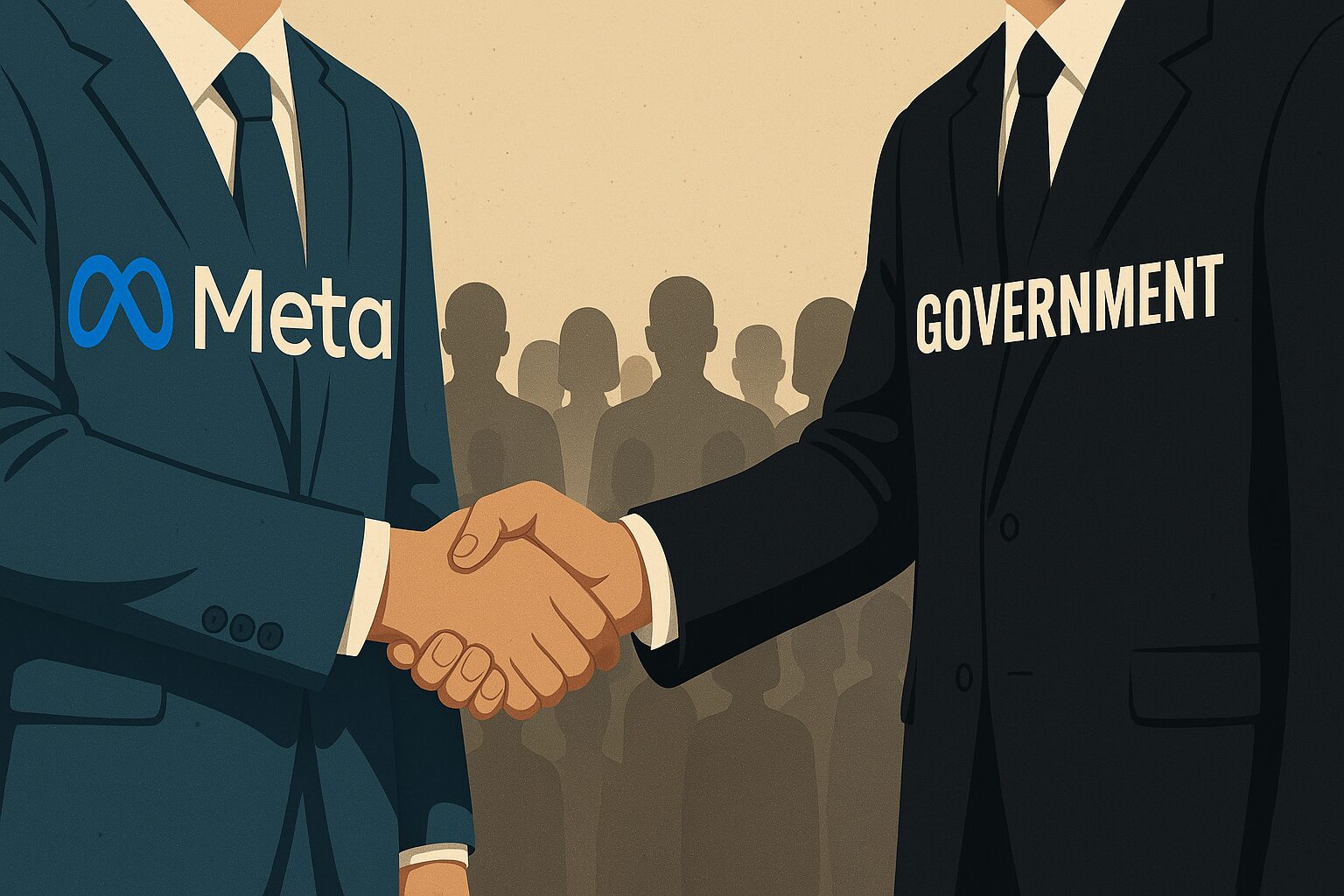
From private profit to public control: Once driven purely by market interests, social media giants like Meta now find themselves entwined with government agendas—raising alarms over surveillance, censorship, and the creeping control of public opinion.
In recent days, the Philippine government summoned executives from social media giant Meta to explain the rise of what officials call “fake news” on its social media platforms. Meta, the parent company of Facebook and Instagram, initially distanced itself from responsibility, saying it is merely a platform and not accountable for the content uploaded by users. However, soon after, Meta announced its cooperation with Philippine authorities to strengthen the fight against disinformation.
On the surface, this may seem like a win against online deceit. But scratch a little deeper, and what emerges is a dangerous move toward silencing alternative voices—and outsourcing that power to a foreign corporation with a long record of surveillance and political influence.
The threat to plurality of opinion
In today’s polarized climate, the term “fake news” has become weaponized. It is increasingly used not just to flag verifiable falsehoods, but also to discredit dissenting views, critical commentary, or independent reporting that challenges mainstream narratives.
What makes this partnership between Meta and the Philippine government deeply troubling is that it reinforces the idea that only state-approved or “mainstream” content is legitimate. This severely marginalizes independent journalism, grassroots content creators, and citizen voices—especially those critical of the political and economic status quo.
This is not a campaign against lies. It is a campaign for narrative control.
A private company with public power
Let us not forget that Meta is a private, profit-driven corporation based in the United States. Its loyalty is not to Filipino democracy, but to its shareholders—and, more importantly, to U.S. law and regulatory pressure.
In fact, Meta’s algorithms have long been accused of amplifying sensationalist content while suppressing independent and alternative voices. The company has the power to decide what trends and what gets buried. Giving it the power to define what is “fake news” in partnership with a national government is akin to deputizing a foreign actor to regulate local discourse.
Surveillance history cannot be ignored
Meta’s past behavior makes it an especially dangerous partner in this context. In 2013, Edward Snowden’s revelations exposed how the U.S. National Security Agency (NSA) operated a secret program called PRISM, through which it gained direct access to the data of users on platforms like Facebook, Google, and others. This wasn’t just about protecting national security—it was mass surveillance on a global scale, including on citizens and leaders of allied nations.
One of the most high-profile victims? German Chancellor Angela Merkel, whose phone conversations were reportedly intercepted by the NSA, causing diplomatic uproar between Berlin and Washington. If even a close ally like Germany is not spared from surveillance, what assurance does a country like the Philippines have?
By handing Meta the role of content gatekeeper in the Philippines, we may also be handing the U.S. government backdoor access to how Filipinos think, what we discuss, and what our political temperature is.
A direct threat to Philippine sovereignty
Let’s be clear: this partnership gives a foreign power—via a corporate proxy—real-time visibility into and potential influence over public opinion in the Philippines. That is not just concerning—it is a violation of our national sovereignty.
Control over narratives is control over the nation’s political consciousness. In effect, Meta’s involvement in identifying and suppressing so-called fake news gives the United States, through its corporate arm, the ability to monitor and even shape our political discourse.
This isn’t about protecting the truth. It’s about protecting power.
The need for a Filipino-centered digital policy
The solution to disinformation is not to partner with foreign corporations that have their own political baggage and strategic interests. Rather, the Philippines must invest in building local, transparent, and accountable mechanismsto educate citizens, support media literacy, and protect press freedom—without compromising the democratic principles of plurality and free expression.
We must also support alternative and independent media platforms that reflect a diverse range of perspectives—not just those that echo state or corporate interests.
Final thoughts
The fight against fake news cannot become a pretext for clamping down on dissent or for allowing foreign tech giants to dictate the boundaries of Filipino public discourse. Meta may promise neutrality, but its history and interests tell a different story.
To entrust it with the power to regulate political conversation in the Philippines is not just short-sighted—it’s dangerous. And if we allow it, we may one day wake up in a country where truth is not determined by facts, but by algorithms—and whose voices are heard not by merit, but by permission.
The views and opinions expressed in this article are those of the author and do not necessarily reflect the official policy or position of PhilSTAR Tech.
