


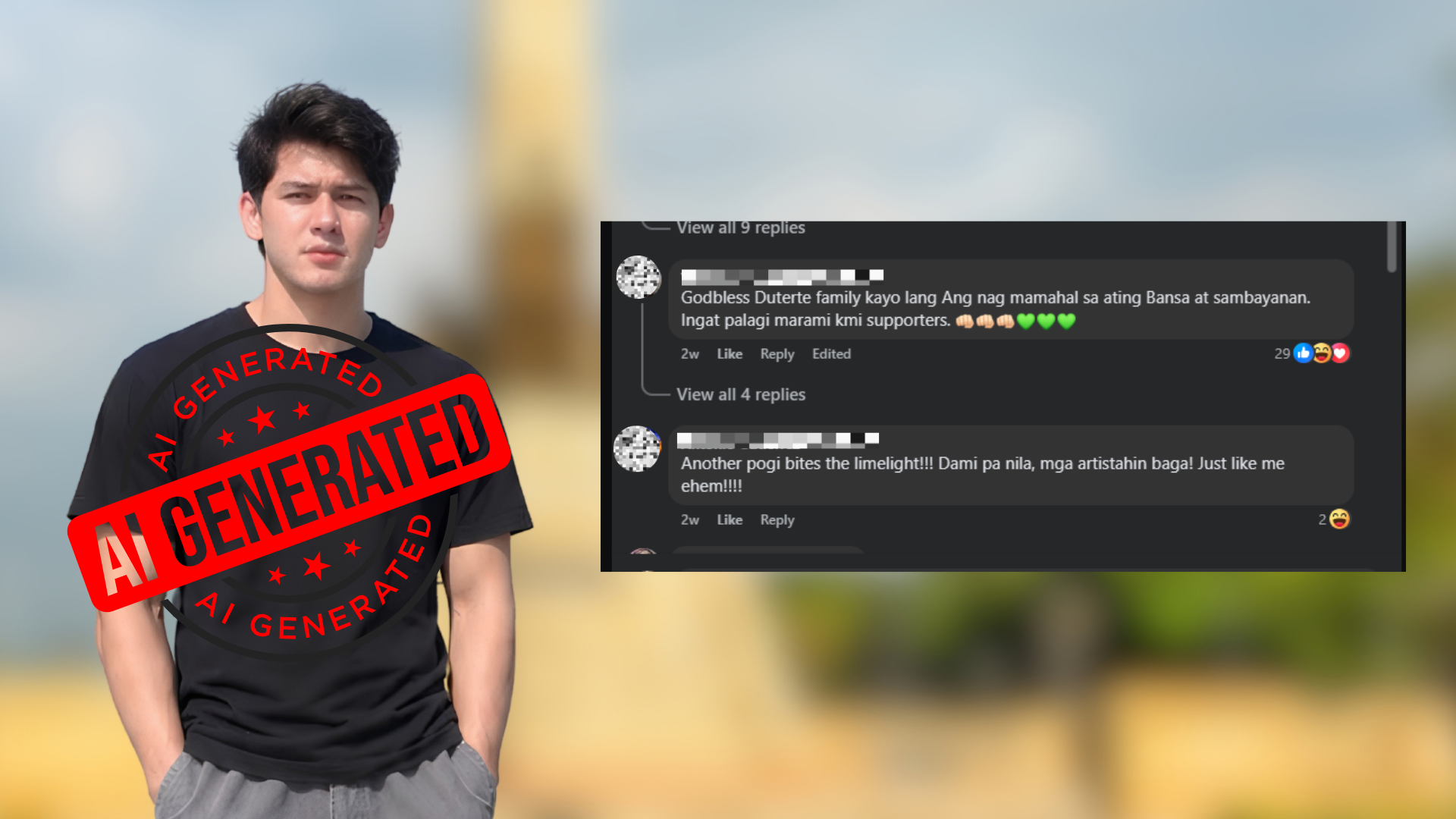
You may have come across some Facebook posts related to a relatively new face bearing the Duterte name. You will sometimes see him posing in front of the Davao City Hall, as well as with his family members, on a Facebook page with over 300,000 followers.

Thousands of supporters flock to his page whenever he posts, a usual for a content creator with a storied family lineage, but there is a catch: there is no trace of him in any public information online, and if you try to look him up on any search platform or on the former president’s Wiki page, pressing CTRL+F will only direct you to three words: ambulances, balanced, and surveillance.
Lance Zimmerman Duterte is an AI-generated persona, and the motivation behind the page’s creation remains unknown.
While efforts to strike down the post have been ongoing, as evident in the comments from the page itself, people still believe that Lance is a living and breathing human being, roaming the streets of Davao City.
The AI literacy crisis

The Philippines is already among the world’s heavy users of generative AI. DataReportal’s Digital 2026 report, using GWI data, found that 42.4 percent of Filipino internet users aged 16 and above had used ChatGPT in the previous month, putting the Philippines sixth among the countries measured.
But knowing how to use AI does not necessarily mean knowing how to recognize when AI is being used against us. Across social media, AI-generated images, videos, and posts are increasingly mixed into ordinary content, often without clear labels and tags.
Some are obvious enough to dismiss; others are convincing enough to attract thousands of reactions before anyone stops to ask whether they are real, creating a cycle that rewards engagement while pushing it even further.
When seeing to believe becomes a challenge
Besides the fake Duterte relative, it reflects a growing challenge within the Philippines in which images can no longer be treated as evidence.
The Reuters Institute’s 2025 Digital News Report found that social media remains an important source of news for Filipinos, while respondents also reported using fact-checking sites and social media to verify information. The report also found that 9 percent of Filipino respondents had used AI chatbots as a source of news.
While this does not mean that Filipinos will immediately believe everything they see, it forces us to confront these growing problems, as well as question everything we see on the internet, in an era where AI-generated media becomes just as convincing as the images we see in real life.
On the contrary, whenever something is paired with the word ‘AI,’ it doesn’t always mean it’s going to be a bad thing, with its growing use in medicine, fraud prevention, transportation, and all the like, but when it is being used for self-gain, that’s where the problem lies.
Filipinos do not need to stop using AI, but we do need to become more skeptical of what it puts in front of us. Because in a world where almost anything can be fabricated, the ability to question what we see may be more valuable than the technology used to create it.
