

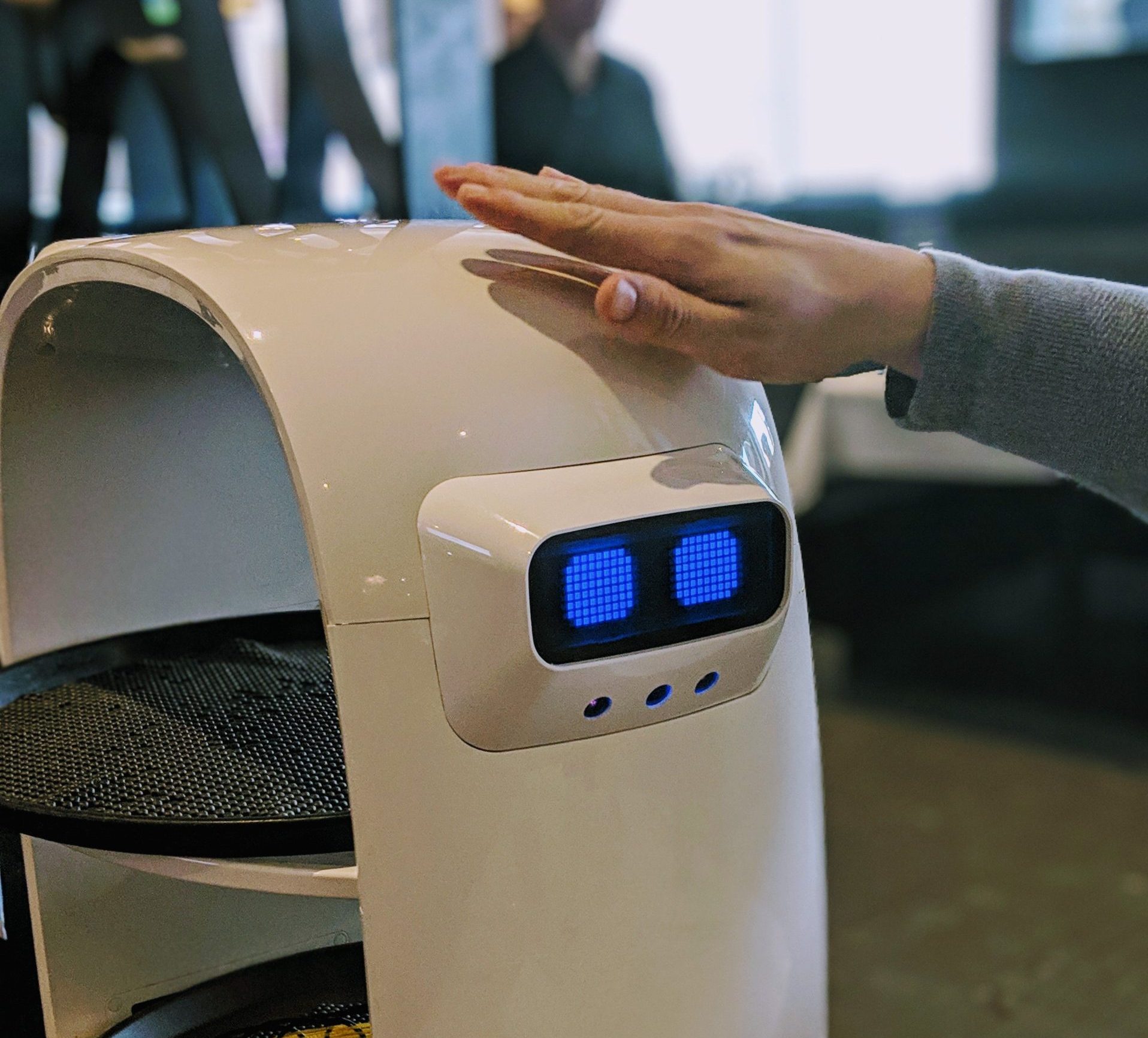
Children bustled around the restaurant, entranced by the vertical machines making rounds across different tables, and Boyet, at 64, watched along in fascination.
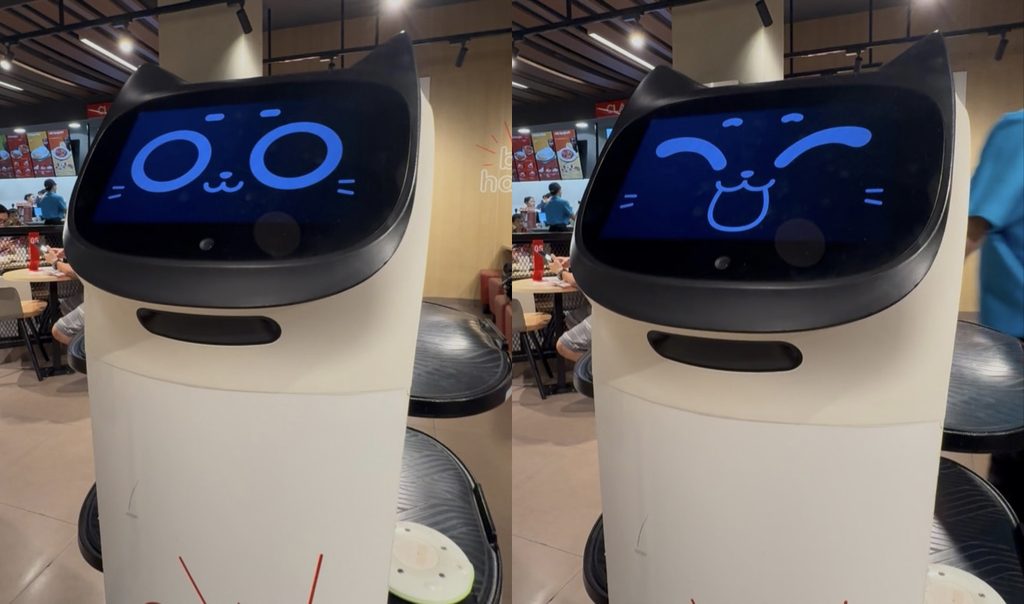
There, among the flock of families and uniformed employees, roamed robot servers that lit in blue and white, greeting hungry diners with whiskery winks and cartoonishly big round eyes.
The scene might as well have been plucked out of a film or a book, as though it was the harmonious prelude to the eventual sequence of disquietude.
Something is usually bound to go wrong in these situations — works of fiction have much proven the integration of robots into society as a recipe for disaster.
But Boyet, who grew up watching the heroic Astro Boy, had faith in such machines. These Jollibots in particular were, after all, an extension of the fast-food chain’s cheerful crew.
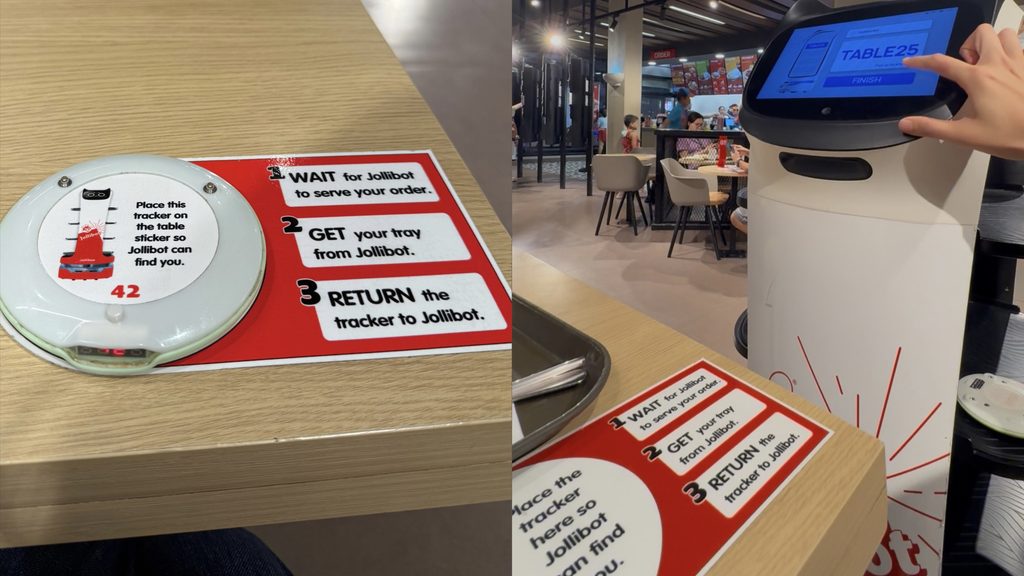
So there, in his chair, he sat tight, keeping an eye on his coaster beeper on the table. He patiently waited. And waited. And… waited for a meal that would never quite make it to his table the way he had anticipated.
“Naghintay ako, siguro, mga mahigit sampung minuto rin,” Boyet recalled. “Kaso mali raw ‘yung pinaglagyan ko ng [beeper] kaya hindi na-detect no’ng robot.”
Eventually, a staff member calling out his queue number jolted a disappointed Boyet up from his seat as he made his way to claim his tray of food over-the-counter.
That was nearly two years ago. He has since learned from his mistake, but apprehension still ripples whenever he steps into establishments with mechanisms that are “too hi-tech.”
However, with the expanding presence of technological innovations in public and private spaces, avoiding interaction with such gadgets may be more difficult than expected.
Rising automation
The year was 2022 when Jollibee, the country’s leading fast-food chain, rolled out the Jollibots.
The droids were labeled as the team’s “on-ground assistants” and were a part of the series of innovations the restaurant launched in select branches to beef up its customer convenience and operation efficiency.
The Jollibot, manufactured by Chinese company Pudu Robotics, is modeled after the AI-powered BellaBot. It bears futuristic and animated features, including its cat-like digital face that morphs into several expressions when interacting with guests.
According to a press release from Jollibee, the robot would primarily help in dispatching orders to allow personnel to attend to urgent tasks, like diners’ requests, during peak hours.
“With the Jollibots, our store teams in select stores are experiencing the benefits of serving their customers even more efficiently,” it said. “While these Jollibots are welcome additions, we have maintained and will continue to keep the same number of crew in these branches as they remain integral to our day-to-day operations.”
Likewise pioneering the use of robot servers in the local dining scene was GoodTaste, a Chinese-Filipino restaurant in Baguio that has, over the years, attracted foodies both residing in and visiting the country’s summer capital.
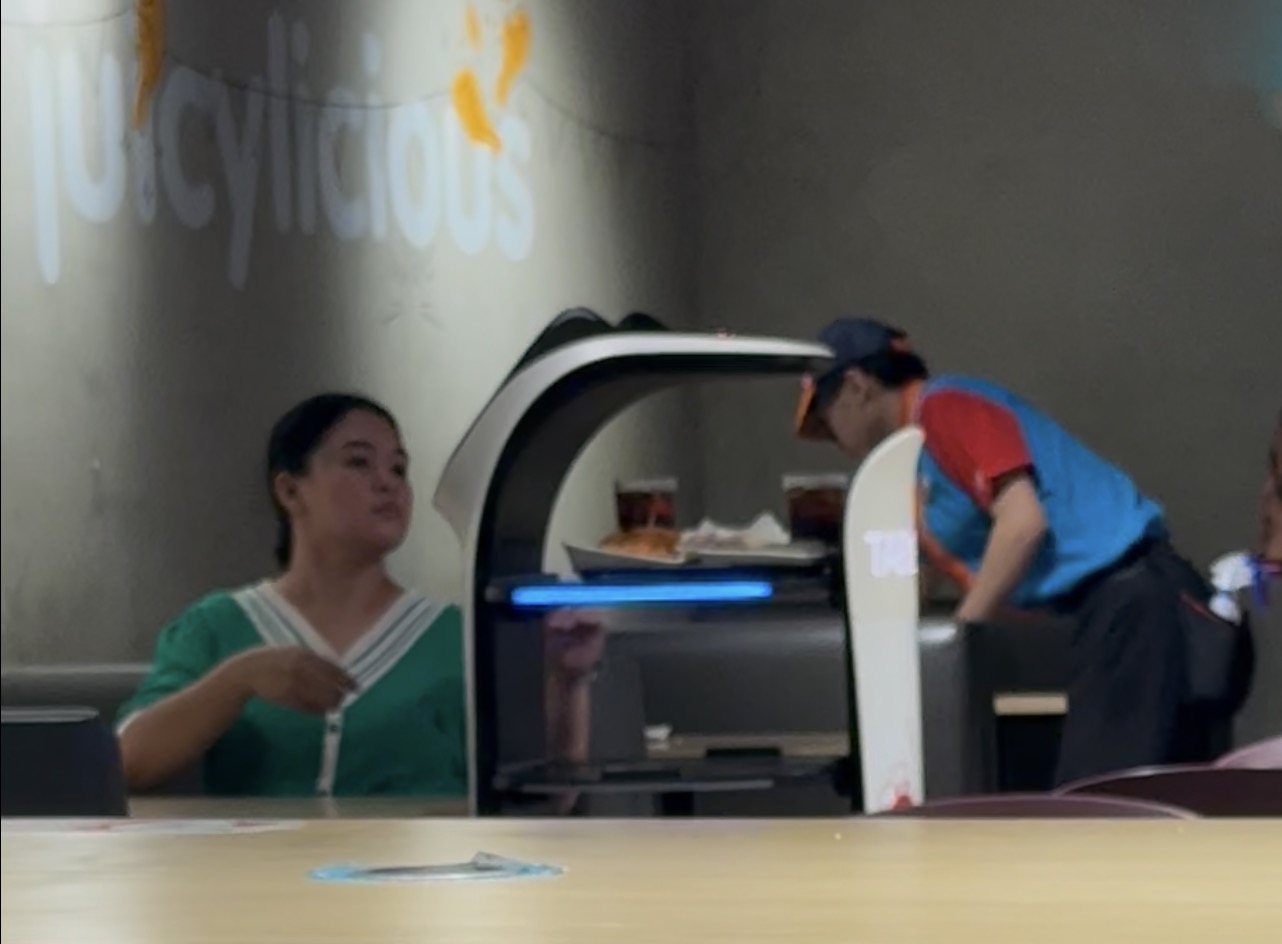
Photo by Zoe Aguinaldo
Also introduced to the public in 2022, the delivery robots became an addition to ease GoodTaste’s daily staff operations and help accommodate the volume of diners while providing “a more innovative and engaging dining experience.”
“We wanted to explore how technology could complement our existing operations while providing customers with something new and interesting,” the GoodTaste management told PhilSTAR Tech.
GoodTaste’s smart helpers, also manufactured by Pudu Robotics, come in two models: the PuduBot 2, which offers a more classic finish with its sleek tray rack design, and the BellaBot.
Although they differ in appearance, both can hold up to 40 kilograms worth of food and drinks and are built with 360-degree motion detection sensors to ensure obstacle avoidance. PuduBot 2 can operate for up to 12 hours, while BellaBot can last an hour longer than the former.
“We started with just one robot server, a BellaBot, and have since expanded our fleet to 10 robots. This growth reflects our continued use of technology as part of the dining experience at GoodTaste,” the management added.
Not larger than life
Despite the high power capacity of these robots, their functions are arguably limited and surprisingly… ordinary.
For instance, the automated servers can only execute task-specific jobs, traversing the dining halls with very calculated movements. Once assigned to a table, they cannot swiftly address customer concerns that they may encounter on the way.
Human servers, on the other hand, can.
This is why the staff, according to the GoodTaste management, remain at the forefront of responding to customer concerns, accommodating special requests and providing personalized assistance.
“Our human employees still perform a much wider range of responsibilities, from assisting customers and coordinating orders to addressing concerns and ensuring that service runs smoothly.”
Working alongside GoodTaste’s robot servers are point-of-sale machines, tablets and self-service kiosks for digital ordering. The restaurant likewise uses food-processing machines and a conveyor belt to streamline its operations.
Although relatively new, these advancements are not rare across enterprises in the Philippines.
Many restaurants have welcomed the inclusion of automation in their day-to-day service operations, with one of the most common manifestations taking the form of a large touch-screen.
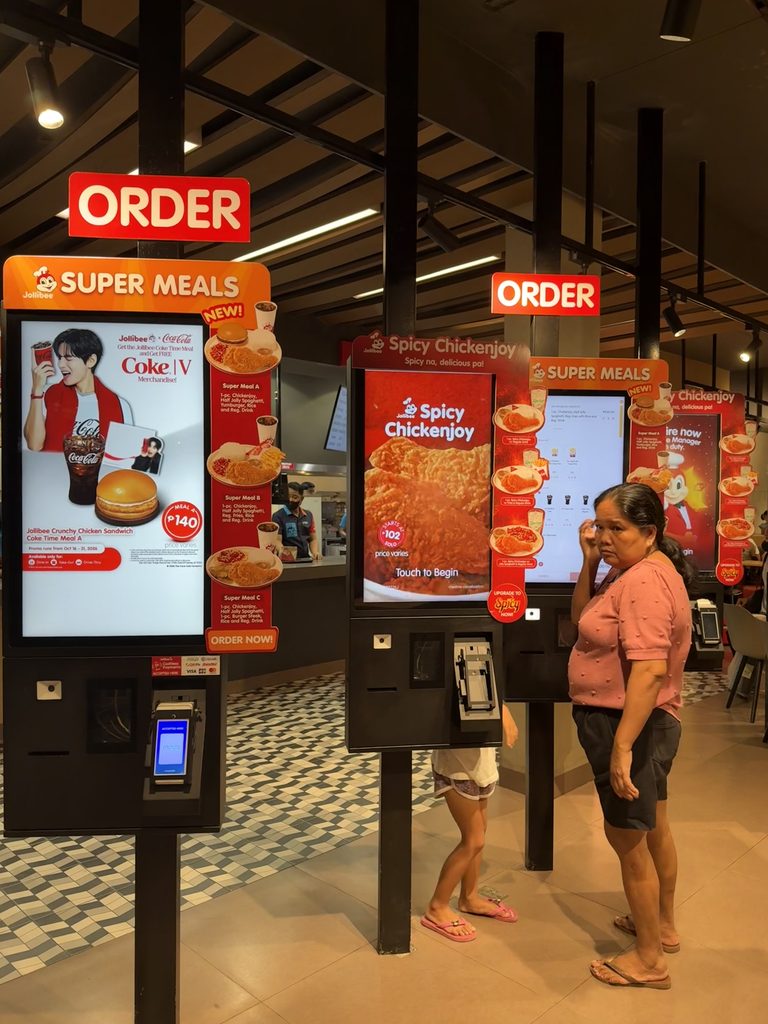
Self-service ordering kiosks, made available in Philippine fast-food chains in 2018, are digital menus that provide an alternative to over-the-counter transactions.
Since these support online payment systems and are reliant on network connection, technical issues, such as server downtimes, remain a common concern among users.
Some have even taken to social media their frustrations with the kiosk, describing the device as rather inconvenient and exclusive of those who struggle adapting to digital tools.
Based on a 2025 study from Mapúa University, there are key factors that may affect customers’ willingness in using kiosks, including performance expectancy, effort expectancy and social influence. These cover aspects such as the users’ perceived benefits and efficiency, ease of use and clarity in utilization of the technology.
Limited technological infrastructure and several inconsistencies demonstrated by robots conversely serve as challenges that reflect the negative impacts on the widespread adoption of robot kiosks in the country, according to the same study.
While customer preference varies when it comes to automated services, the reality is that no one is exempted from dealing with their technical setbacks — not even younger individuals who are usually more adept at handling technology.
Twenty-two-year-old Vince Laranjo, who used to frequent fast-food restaurants during his college years, recalled long waiting times in the queue whenever the majority of the self-ordering kiosks were not working.
“I think naka-encounter ako [ng] ganito sa McDo na hindi talaga nagana so parang ni-limit sa two [kiosks]. So, nag-open sila ng over-the-counter orders.”
For him, self-ordering kiosks can be useful for those paying cashless or those watching their budget since they have immediate access to their running total.
On the other hand, he said, over-the-counter services remain unmatched as staff members are much more readily available when it comes to communicating concerns that may arise from their orders.
“Mas prefer ko pa rin kasi talaga ‘yung sa counter kasi kung may problema, hindi agad ‘yun sa ’yo agad masasabi ng machine lagi. At least sa counter, alam ko,” Laranjo said.
“Kahit mag-automate sila ng ilang bagay, the heart of fast-food chains is ‘yung staff talaga na naglilingkod do’n.”
Complements, not opponents
Although these technologies serve different purposes, they share a common objective: to lighten the load of the staff without compromising the quality of the restaurant’s services.
In the food industry, employees are usually chasing tasks in the kitchen and dining areas, going back and forth between taking orders and bussing tables to make way for eager customers.
These demands train employees to multitask not by choice but by necessity.
With automation, however, human employees can leave much of these routines to machines and focus on what they do best: creating personal experiences for every customer.
Through this, employees can spend more time delivering heartfelt hospitality to diners, according to Prof. Anthony James Bautista of the University of Santo Tomas Department of Mechanical Engineering.
“Autonomous service robots bring massive advantages to the food industry by taking over repetitive tasks like serving food and clearing tables,” said Bautista, who specializes in the development of service robots.
“Because robots do not get tired, businesses lower operational strain and long-term overhead costs.”
Like Jollibee, GoodTaste understands the limits of automation and believes that robots are deployed not to replace traditional human servers rather to assist them.
“Robot servers offer a different kind of dining experience by introducing an element of novelty and interaction…However, we do not consider robot-assisted service superior to traditional human service in every aspect,” it said.
Lingering fear
But sometimes, not even the most frequent of assurances can put to rest one’s fear of replacement.
Regardless of the barriers that come with introducing new technology, employees are well-aware of its potential in improving a restaurant’s day-to-day operations.
This was reported in a 2025 qualitative study from St. Vincent’s College Incorporated, wherein employees largely perceived the usefulness of self-ordering kiosks in reducing manual order-taking and raising the team’s overall productivity.
At the same time, some employees identified disadvantages like system limitations, technical glitches and confusion over the device’s function, which they said tend to lead to delays, added workload among the staff and tension with customers.
In a separate study from the University of La Salette, restaurant managers and customers expressed a high acceptance in self-ordering kiosks, while staff members exhibited the most skepticism — a behavior the paper linked to potential fears about job security and changes in customer interaction.
Under the Philippine law, the installation of labor-saving devices serves as a just cause for the termination of employees. Affected workers must, in return, receive a separation pay equating to at least their one-month pay or one-month pay for every year of service, whichever is higher.
Rapid innovation and artificial intelligence adoption may also make about 76% of Philippine jobs vulnerable to automation by 2030, according to a recent paper from Asian Development Bank Institute on Asia’s workforce. The market’s shift to capital-intensive manufacturing, it reported, is likewise causing “severe” disruption in the service sector, especially in the business process outsourcing and information technology services.
Despite the perceived risks of technological displacements among workers, employment under the country’s restaurant and food industry remains high.
Official data from the Philippine Statistics Authority showed restaurants and mobile food service activities as the country’s leading industry group that employed the highest number of workers in 2024 under the Accommodation and Food Service Activities Section. The group accounted for 349,629 workers or 67.2% of the category’s total employment, which stood at 520,642.
For industrial and labor relations expert Asst. Prof. Benjamin Velasco of the University of the Philippines Diliman, automation is unlikely to further expand in restaurants as the “human element” is relevant in completing customers’ dining experience.
“Robots will not hugely improve efficiency in flipping and serving burgers, especially with the presence of low-wage workers. So, massive job losses due to automation in the food service industry is not in the immediate horizon,” he said.
“While there are efficiency dividends in digitalization of services, it is limited by client preference for human interaction. Utilization of AI may finally bridge that gap.”
What the country needs, Velasco claimed, is to properly implement its declared policy of just transition for workers and businesses affected by risks stemming from technological innovation.
Bautista shared similar views, citing the importance of forward-looking workforce protection policies to achieve a balanced transition to human-robot collaboration.
He also noted that the country lags behind neighboring Asian countries in industrial digital transformation and commercialization.
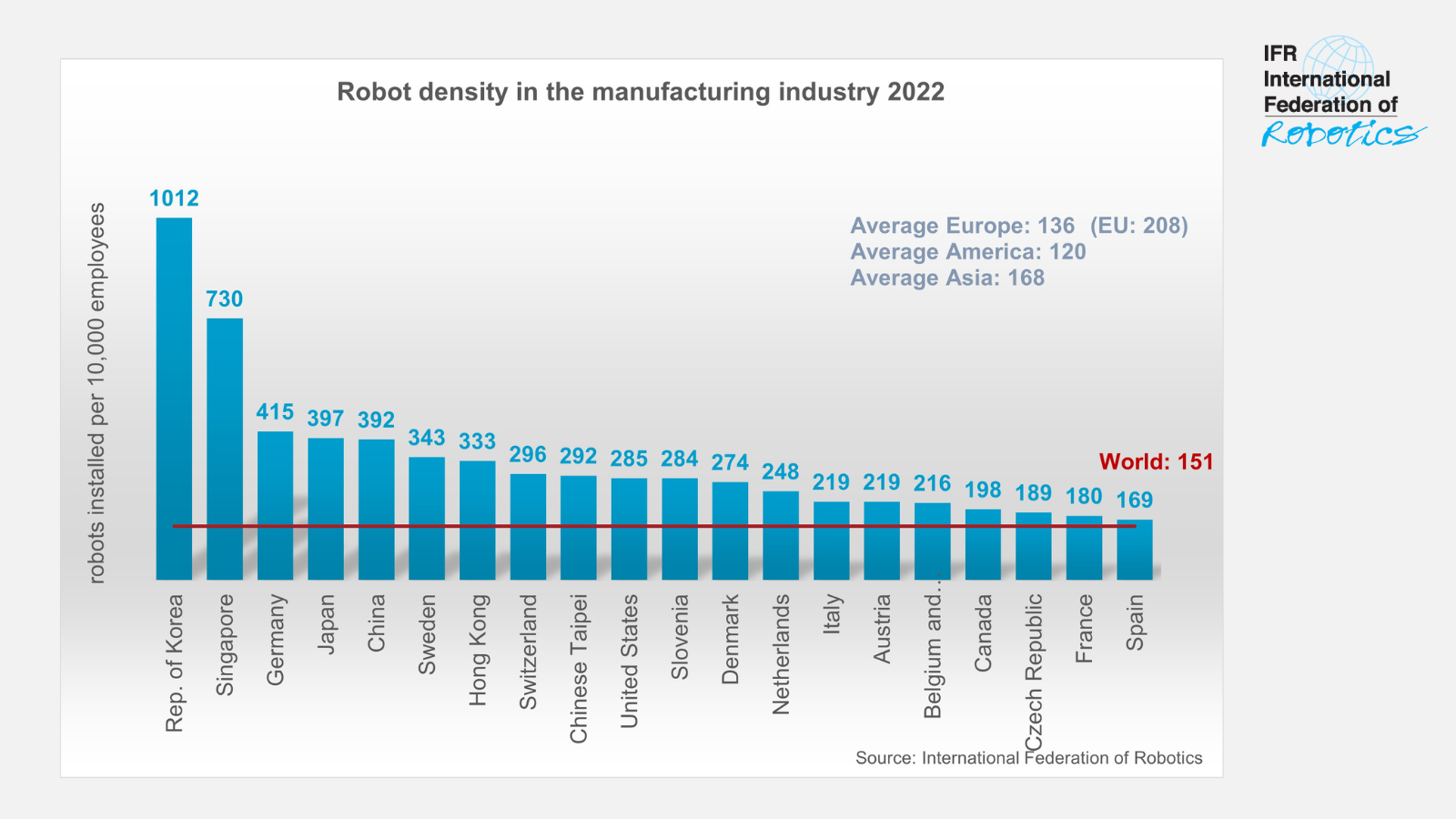
The top most automated countries measured by robot density in 2022 are South Korea (1,012), Singapore (730), Japan (397) and China (392), as shown by data from the International Federation of Robotics.
Meanwhile, the Philippines, Bautista said, sits far below the global average of 151 robots per 10,000 employees.
“Rather than replacing staff, policies must incentivize businesses to retrain workers displaced from routine tasks for higher-value roles in customer relations, quality control and inventory management,” he added.
The national government has likewise recognized the need for the digital upskilling of Filipinos to keep pace with the global labor market, with the release of the Implementing Rules and Regulations of the Philippine Digital Workforce Competitiveness Act or Republic Act No. 11927 in 2023.
The law seeks to provide Filipinos access to programs that will make them competent in adapting to emerging technology such as digital content, platforms, innovations and entrepreneurship.
Divided by age
A study from De La Salle University found younger respondents, aged 18 to 25, to acquire higher satisfaction on self-ordering kiosks compared with respondents aged 60 and above.
Aside from the role of age in technology usage and satisfaction, this, according to the researchers, displays the youth’s familiarity with digital systems as well as a preference for traditional ordering methods among the older generation.
Laranjo, for instance, takes charge in ordering meals for him and his 65-year-old mother in restaurants with such machines.
“Tinuturuan ko rin naman para maka-keep up siya kahit papano pero…hindi rin naman gano’n kadali mag-adjust [para sa kanya], lalo na ‘yung generation niya is mas sanay na over-the-counter,” he said.
Such is the case for Boyet, who does not pass up the chance to ask the staff if they support over-the-counter transactions.
Though he acknowledged the leverage that modernized restaurants have over purely traditional ones, Boyet admitted that he requires assistance from his grandchildren in terms of participating in such settings.
There also remain occasions of intimidation at the sight of devices he considers foreign, but Boyet hopes he can count on the people behind such innovations in ensuring that they are accessible across all generations.
Receptiveness, the elderly added, would pay off over one’s refusal to be challenged by these advancements. However, he maintained that it should not come at the cost of people’s convenience.
“Ako, hindi ko naman tinatakwil ‘yang mga ‘yan (technological advancements). Pero dapat sana inaayon nila (manufacturers) ‘to sa kakayahan ng mga nagmula sa kahit na anong kapanahunan — mapabata, mapamatanda.”
“Nang sa gayon ay walang naiiwan,” Boyet said. “Nang sa lahat [ay] nakasasabay.”