


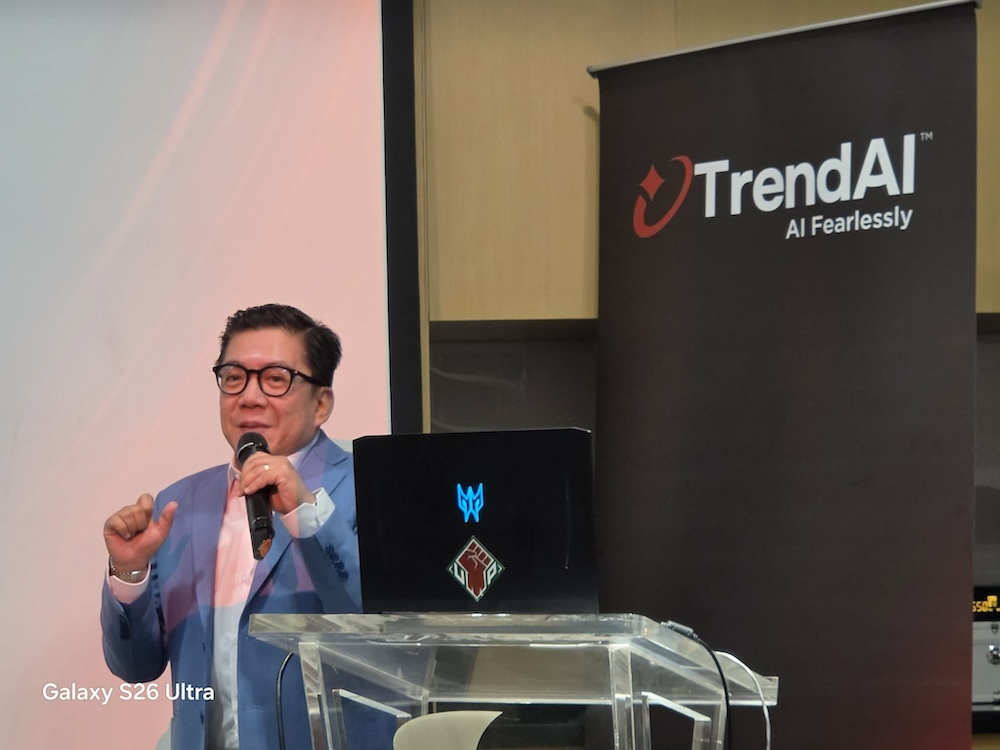
Trend Micro is reshaping its cybersecurity strategy around artificial intelligence (AI), shifting toward what it describes as more proactive, AI-driven protection as digital systems become more complex and interconnected.
Its enterprise unit is now called TrendAI.
“We believe that AI is not just here and here to stay, but AI is changing the way we do things, changing our lives, our business process, the way companies operate,” said Ian Felipe, country manager of Trend Micro Philippines. “So it is very important that we transition as well in this journey, together with customers.”
Felipe said the shift is driven by how quickly AI is changing business operations and everyday digital behavior. He added that while AI is not new to the company, the current shift is about making its role in AI security more visible as adoption accelerates.
“Obviously AI is not really new, because from the very beginning, we’ve been doing this internally. But it is very high time for us to share with everyone, while everybody transitions and adapts to AI, to partner with a company like us, securing the AI adoption, securing the AI journey of our customers,” Felipe said.
As part of the strategy shift, the company is reorganizing its business into clearer segments focused on enterprise, consumer, and specialized environments such as industrial systems and connected infrastructure, along with advisory services around AI adoption.
Felipe said the enterprise cybersecurity business will be positioned under an AI-focused unit, while consumer security will remain a separate line aimed at personal devices and home users.
“For those who know us, we’ve been here in the Philippines as well. Thank you, and welcome,” he said. “We have already identified which is the consumer business and the enterprise business.”
He explained that consumer protection covers mobile devices, laptops, and home use, while enterprise security focuses on large organizations managing complex IT systems.
The company also maintains a separate focus on protecting operational technology environments, such as hospitals, utilities, and industrial systems that may not always be connected to the internet but still require security coverage.
Another unit focuses on AI consulting, helping organizations understand and adopt AI systems while managing associated risks.
Felipe said the shift indicates how AI is increasing both opportunity and risk across industries.
“As they adapt to AI, they will implement a lot of technologies. And as they adapt to technologies, it increases the risk surface of all organizations,” he said.
He added that the industry is moving away from purely reactive cybersecurity toward more predictive and preventive models.
“From reactive before, it is important for organizations to be able to react fast. But now it’s shifting. It’s not about reacting, it’s about proactive security,” Felipe said.
The company said it operates in 75 countries with about 6,000 employees globally, and supports more than 25,000 enterprise organizations. It also maintains 14 global threat research centers.
The Philippines is one of its largest global operations, with around 1,100 employees.
Felipe said the company’s approach to cybersecurity is rooted in identifying vulnerabilities early, allowing organizations to stay protected even while software fixes are still being developed.
