


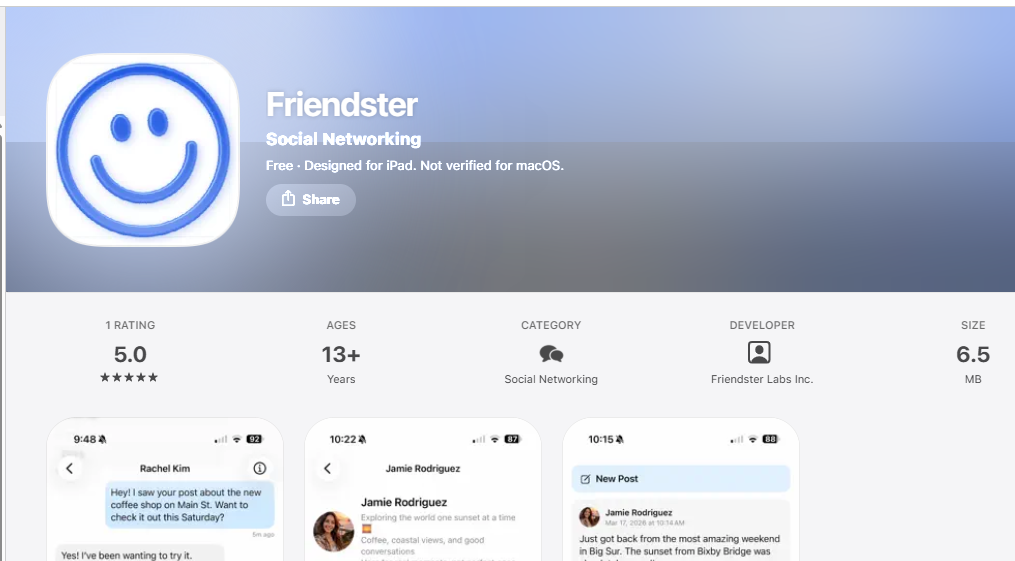
Before Facebook, or even LinkedIn, there was Friendster where you added people you actually knew to share stories with, and not just to build a network or collect followers.
What made Friendster feel different wasn’t just the smaller, or more personal circles, but also its much simpler and organized interface. Instead of scrolling feeds, you have your profile where friends can check out whenever they want to. It’s just a single page where you can customize and add elements to build your identity.
Friendster was founded in 2002 and shut down in 2015. At its peak, it was a dominant platform, along with MySpace, before being overtaken by newer networks.
Today, Friendster has relaunched as an ad-free social media platform, introducing a simplified, privacy-focused model that removes algorithms, advertising and data tracking.
Now available as a mobile app, Friendster says it hopes to be seen as a “simple, private social network” built around real-world connections. Unlike modern platforms that rely on discovery and reach, it limits networks to people users are likely to know personally.
The company says there are no ads, no algorithm-driven feeds and no engagement-based content ranking. It further rejects practices such as “engagement bait” and “rage farming,” which are widely used to boost user activity on larger platforms.
The platform adds that it does not sell user data, underscoring a privacy-first approach.
The relaunch comes as concerns grow over the influence of major social media companies, including Meta Platforms, particularly in areas such as targeted advertising.
Friendster was among the most popular social networking platforms in the early 2000s, especially in the Philippines and across Southeast Asia, before being overtaken by newer platforms.
The relaunched platform is currently available only on iPhone, with no Android version announced
