


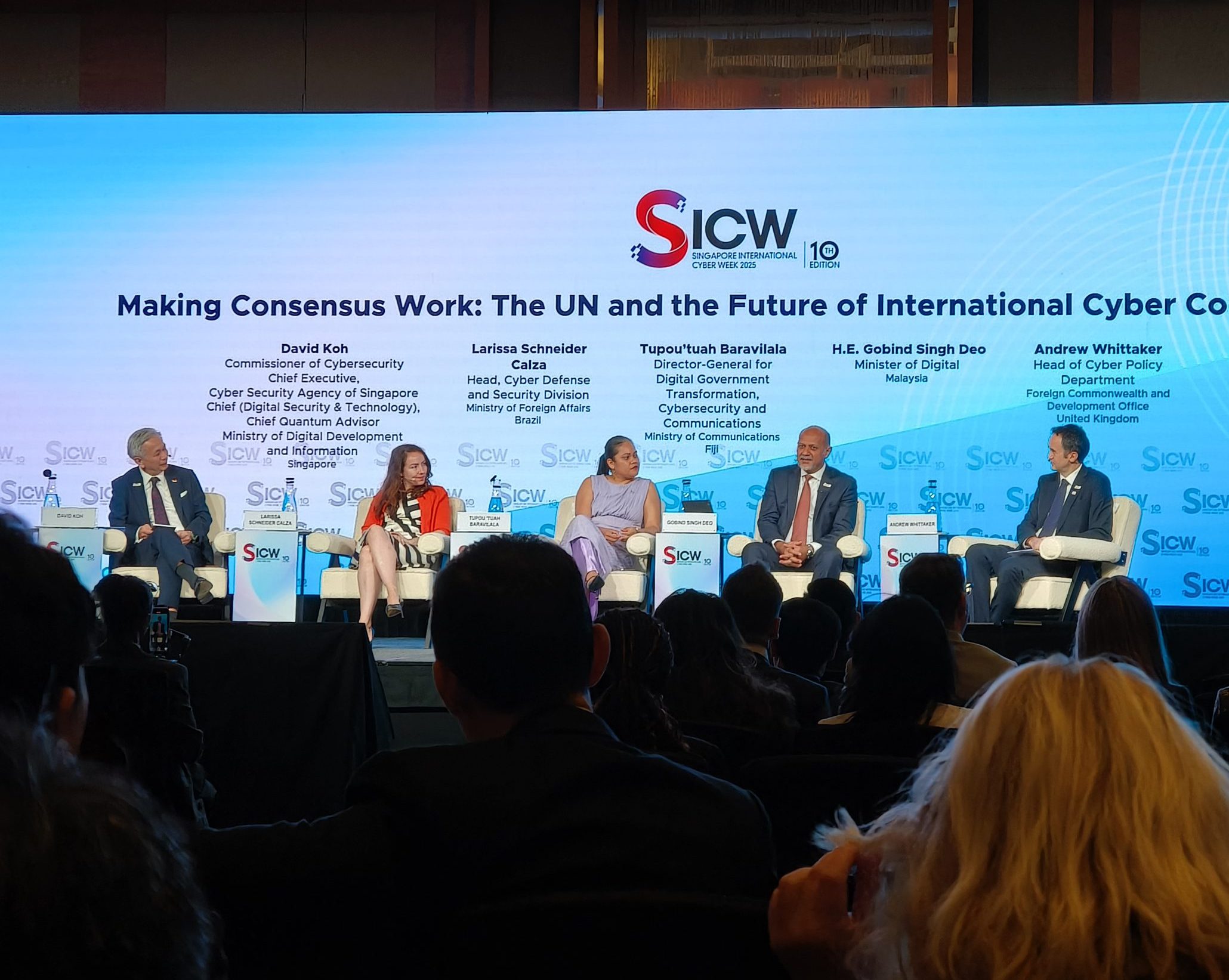
Singapore’s biggest cybersecurity gathering opened not with fanfare, but with a sense of urgency. In the form of the recognition that dialogue may be the last defense left online.
The event’s scale reflects how much the region’s priorities have shifted, Cyber Security Agency of Singapore chief executive David Koh said.
“This conference is not just a regional conference. I think It’s globally number one or number two in the world,” Koh said during a breakfast interview with the media on the last day of the Singapore International Cyber Week (SICW) 2025, October 23.

Now in its tenth year, the SICW has grown from a local policy forum into one of the largest cybersecurity events in Asia, drawing over 13,000 participants from governments, private companies, and civil society.
This year’s focus on the next era of global cybersecurity touches on the technologies shaping new risks, as governments begin to confront the realities of regulating what they barely understand.
For this reason, Singapore used the occasion to release new guides on securing AI systems and preparing for post-quantum encryption, part of its ongoing effort to set the pace for digital governance in the region.
Koh said SICW’s growth was driven less by promotion than by what he called “network effect.”
From a modest start, SICW has evolved into a rare venue where global cybersecurity meets regional cooperation. The gathering stood as a reminder that, in a fragmented world, some conversations still have to happen face to face.
A neutral ground for digital diplomacy
Koh often describes the event as “a buffet.” Too wide-ranging to take in fully, but open enough that even adversaries still show up.
“There are not many places in the world where you find China, Russia, the US, and the EU in the same room,” Koh said.
That inclusivity has made SICW one of the few neutral platforms left for digital diplomacy. Singapore treats cybersecurity as a shared concern.
“If you don’t have the difficult conversations, then downstream, you’ll face more difficult consequences,” Koh said.
Inside the conference halls, the tone is less confrontational than careful. Panels shift from technical briefings to closed-door discussions on governance and threat response..
Amid rising global tensions, SICW’s format feels almost old-fashioned: countries sending delegations not to sign deals, but simply to talk.
For many participants, those side conversations matter more than the official sessions, functioning as quiet backchannels between states that rarely meet in the same setting.
Koh said the goal is to keep communication open, even among competitors.
“You’re not talking, there will be bigger trouble. So, we provide a platform for people to speak,” Koh said.
For ASEAN, whose digital economies are expanding faster than their security frameworks, Singapore’s approach offers a useful model.
The bloc remains the only regional group to adopt the United Nations’ voluntary norms of responsible behavior in cyberspace, and Singapore has often led the effort to translate those principles into practice.
Cybersecurity as shared responsibility
During the week, Singapore also hosted the 10th ASEAN Ministerial Conference on Cybersecurity (AMCC), where ministers reaffirmed their commitment to strengthen the region’s collective cyber resilience.
The meeting underscored ASEAN’s efforts to turn broad principles of digital cooperation into tangible actions that can be implemented across member states.
Beneath the diplomacy, Koh’s message remains pragmatic, which is cybersecurity is less about control than continuity.
Moreover, the CSA chief executive said cybersecurity plays a vital role in national development, enabling countries to grow and thrive in the digital age.
“The digital environment has actually allowed our citizens to benefit tremendously. You get education, you get access to information, you get potentially new jobs. The economy can grow,” Koh said.
However, Koh also said that all developments come with a risk, and through cybersecurity is how the world can manage the risks.
By inviting both allies and rivals to the same table, Koh asserted that cybersecurity is not merely a technical field but a form of soft power. One that depends on keeping conversations alive, even when consensus feels impossible.
“All of the ASEAN members, together with dialogue partners, were present and all talking about this in order to deal with the challenges, so that our countries and our citizens can benefit,” Koh said.
For Southeast Asia, where rapid digital adoption often outpaces regulation, that consistency may be its strongest export—not the technology itself, but the ability to keep dialogue open and to find, in an increasingly divided world, a common language worth defending.
