


When people hear the word tariff, (my) eyes glaze over. It sounds like something only economists or trade lawyers should care about. But what if I told you those same tariffs could quietly mess with your gadget budget, delay your next console launch, or drive up the price of your favorite earbuds?
Here’s what’s really going on and why it matters, even here in the Philippines.
First, what are tariffs?
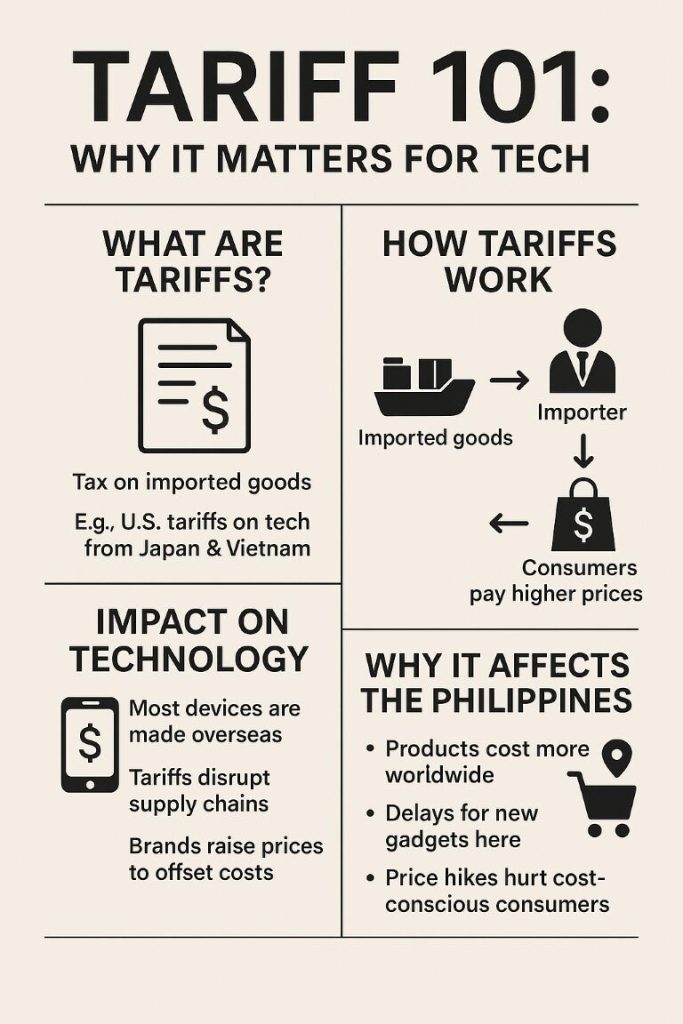
A tariff is a tax that a government puts on imported goods. For example, when a U.S. company brings in smartphones or consoles from Japan or Vietnam, they have to pay extra taxes at the border.
Those added costs don’t just disappear—they usually get passed on to the consumer in the form of higher prices or delays.
What’s happening now?
The U.S. has introduced new tariffs on goods from multiple countries, many of which are key players in the tech manufacturing world.
As of April 2025:
- A baseline 10% tariff is now applied to most imports into the U.S.
- Country-specific tariffs have also been introduced, including:
- China – 54%
- Vietnam – 46%
- Cambodia – 49%
- Taiwan – 32%
- India – 26%
- European Union – 20%
- South Korea – 25%
- Japan – 24%
This is no longer just a Vietnam-or-Japan situation. These new tariffs hit a broad swath of Asia and beyond—regions that are absolutely crucial to the tech world.
Already, Nintendo delayed U.S. preorders of the Switch 2 to reassess pricing and supply chain impact. But that’s likely just the beginning.
Why tech is especially vulnerable
▪️Most of your gadgets are made overseas.
Phones, laptops, consoles, even power banks—they’re often assembled in Asia and shipped globally.
▪️Supply chains are fragile.
One tariff can trigger a ripple effect—suppliers scramble, costs shift, and companies start cutting corners or slowing down rollouts.
▪️Brands will protect profit margins.
If they’re paying more to import, they’ll charge more to sell. And even if the product isn’t launching in the U.S., the global pricing model could adjust.
Why this matters for the Philippines
You might think, “Well, we’re not the U.S., so why should we care?”
Here’s why:
#1 — We import the same tech.
Global product pricing is often pegged to U.S. benchmarks. If a device costs more in the U.S., don’t be surprised when prices inch up in Southeast Asia too.
#2 — We’re already price-sensitive.
Filipino consumers are highly cost-conscious. A $10–$20 hike on a device like a smartphone or tablet could make it unaffordable for many.
#3 — Launches could be delayed here too.
If global supply chains get messy, Southeast Asia often gets deprioritized. That means slower availability, limited stocks, and higher markups.
#4 — Smaller local retailers will feel it.
Many Pinoy gadget shops source stock from U.S.-based gray markets or parallel importers. Tariffs raise those costs, too.
But don’t we mostly buy China-made tech? So why should U.S. tariffs bother us?
It’s true—a lot of tech products in the Philippines are from Chinese brands like Xiaomi, realme, HUAWEI, Infinix, and Lenovo. These tend to be priced competitively and cater well to budget-conscious Pinoy consumers. So on the surface, it may seem like U.S. tariffs on Vietnam or Japan shouldn’t matter to us.
But here’s why they still do:
#1 — We’re part of a global supply chain.
Even if a product is assembled in China, its parts often come from Japan, Vietnam, Taiwan, or South Korea. If those components get more expensive due to tariffs, the final product’s price can still go up.
#2 — Chinese brands still rely on U.S.-tied platforms.
Many Chinese tech companies rely on U.S.-developed software (like Android or Windows), chips, and logistics infrastructure. Disruption in one part of the system can affect the whole chain.
#3 — Price pressure trickles down.
If the U.S. market sees price increases due to tariffs, global pricing models can shift. Companies may raise prices in other regions to balance their margins.
#4 — Even non-U.S. brands respond to U.S. trends.
The U.S. is a major global market. If a product launch is scaled back or delayed there, it can trigger production shifts, affecting availability and pricing here.
So yes, we buy a lot of China-made tech but we’re still tied to a global economy. U.S. tariffs don’t just stop at the border. The ripple effects spread, and countries like the Philippines often feel the shake-up.
So… what now?
We’re entering a world where global trade decisions—like U.S. tariffs—have ripple effects far beyond borders. And for tech lovers, that could mean:
- Higher prices
- Slower launches
- Less availability
- More second-guessing before upgrading
I’ll be honest—I’ve been trying not to take tariffs too seriously. For a while, it felt like something happening in the background, more about politics than anything else. But the more I follow these changes, especially as someone who writes about tech and consumer habits, the more I realize this is something we all need to start paying attention to.
The effects aren’t theoretical anymore. They’re already showing up in delayed console preorders, in shifting prices, in the uncertainty around the gadgets we rely on every day. And as days go by, it’s clear that tariffs aren’t just trade talk anymore—they’re shaping the future of tech in ways we can’t afford to ignore.
That said—this isn’t a call to panic.
Tech isn’t suddenly disappearing, and not every price tag is going to skyrocket overnight. These changes won’t hit all at once, and in some cases, brands may absorb the costs or adjust quietly behind the scenes.
But it’s still worth being aware. Understanding what’s happening in the background helps us make better choices whether you’re planning your next big tech purchase, covering product news, or simply trying to budget smarter. Being informed doesn’t mean being alarmed—it just means being ready.
So, what’s the bottom line?
Tariffs might sound like politics you can ignore but in reality, they shape the price tags and timelines of your favorite tech. And while these new policies are U.S.-based, they’re quietly shifting the global consumer landscape—including ours.
So the next time someone says, “Why is this gadget so expensive now?”—you might just have the answer.
