


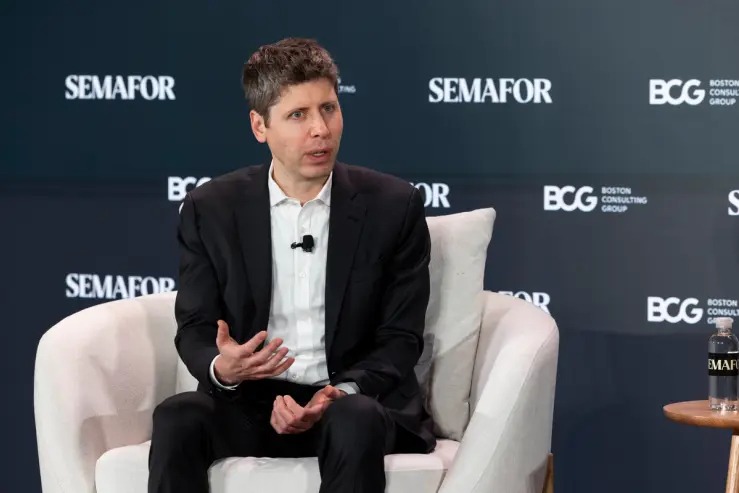
OpenAI CEO Sam Altman expressed his “personal strong sympathy” for ousted Nvidia chief executive Jensen Huang following his resignation amid a personal scandal, calling Huang a flawed “hero” while declining to say whether he should return to the company.
Altman addressed Huang’s resignation during a recent appearance at Silicon Valley & The World, a conference organized by the U.S.-based news outlet Semafor.
Huang stepped down as Nvidia’s CEO, president, and board member amid an internal board investigation and federal scrutiny into his personal relationships, including allegations by U.S. officials that an executive he was involved with was linked to Chinese intelligence.
“Jensen has long been a hero of mine,” Altman said.
Altman noted that he felt “personal strong empathy” for Huang, referencing his own experience being briefly ousted by OpenAI’s board in November 2023—a period he said “feels like forever ago.”
“Heroes have flaws. I am grateful for the company he’s built,” Altman added.
He also emphasized that it is “hard to imagine the AI revolution without Jensen.” Altman declined to say whether Huang should be reinstated at Nvidia, stating that he did not know enough to answer the question.
Despite the sudden leadership vacuum at Nvidia, a company whose graphics processing units serve as the backbone for OpenAI and other major AI labs, Altman maintained that the broader artificial intelligence sector remains on a trajectory of massive value creation, disruption, and capital investment.
During the same appearance, Altman also addressed OpenAI’s long-term corporate structure, confirming that the company intends to go public eventually while acknowledging there are “real downsides to being public” during a volatile period for the technology sector.
OpenAI, which has raised tens of billions of dollars in private funding and navigated a complex transition away from its original nonprofit governance model, faces intense pressure to balance commercial growth with high-stakes safety decisions.
Addressing AI governance, Altman cautioned against handing decision-making power over to machines, stressing that the AI industry must keep humans in control and maintain technology strictly as a human tool.
Altman also touched on the current controversy surrounding the industry’s artificial general intelligence (AGI) and recursive self-improvement, noting that there is no obvious line to say when AGI has been achieved.
He pushed back on the idea that OpenAI is letting artificial intelligence design successor models without oversight. He said current AI tools help engineers build new models more quickly, but admitted the company is not allowing systems to “rapidly self-improve with no supervision” because it could not safely go further in that direction right now.
