

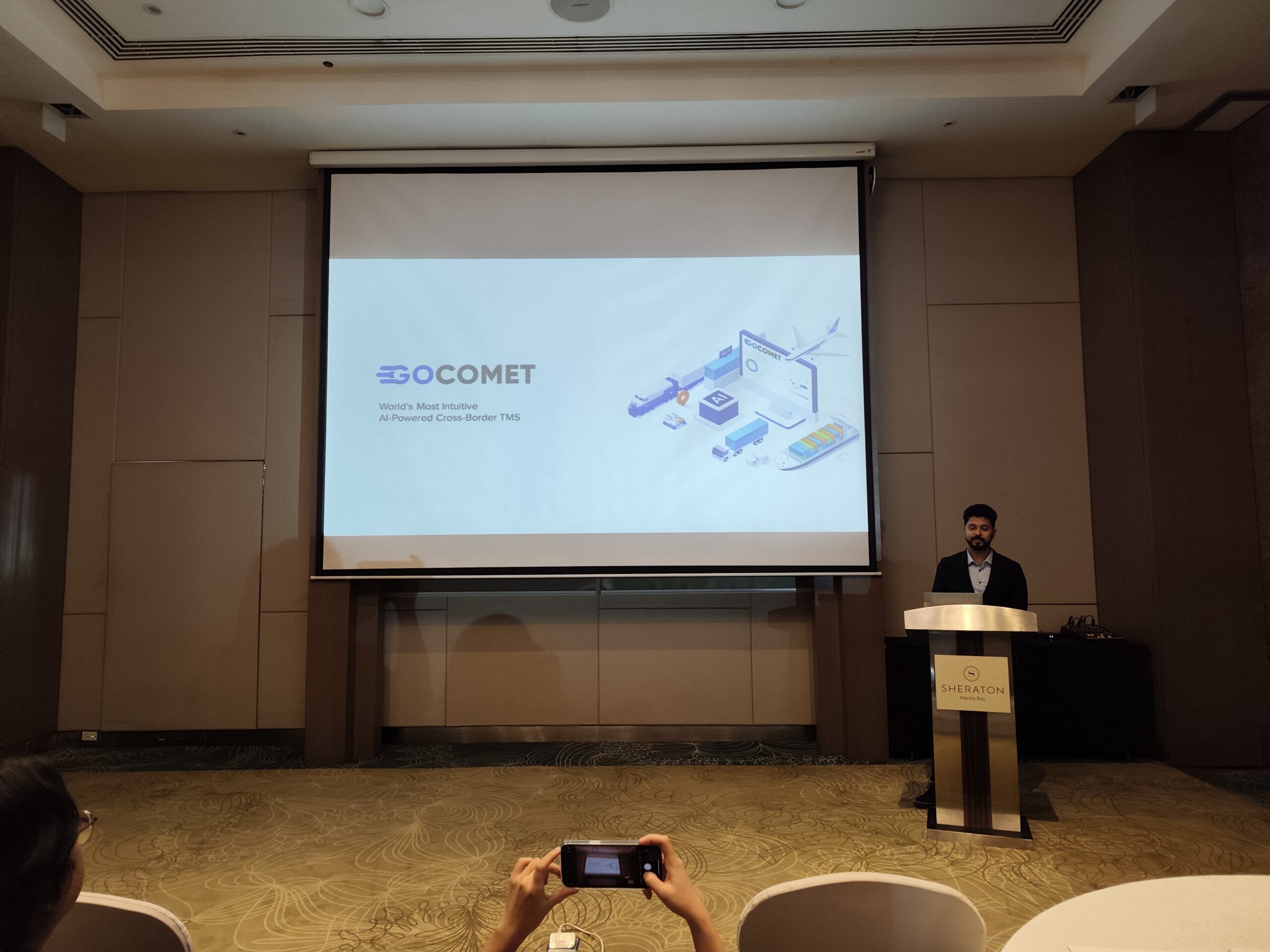
Logistics technology firm GoComet has unveiled artificial intelligence systems capable of tracking and interpreting real-time geopolitical, port, and weather data to help enterprises anticipate disruptions and make faster decisions across their supply chains.
Introduced during the company’s Horizon Manila 2026 forum at the Sheraton Manila Bay on January 22, 2026, the new AI Centre consolidates multiple intelligent systems that continuously observe global operations and provide actionable insights for planning, execution, and risk management.
“The impact is a better cash flow cycle. from an insurance perspective, from a lead time perspective. You can reroute your supply, your logistics as well as foresee any political, geopolitical risk,” Chitransh Sahai, Cofounder & CEO of GoComet, told reporters before the launch.
One of the AI Centre’s key components, Incident Lens, integrates live signals from ports, weather systems, and geopolitical developments directly into shipment monitoring.
The tool alerts supply chain teams to emerging risks such as route blockages or trade restrictions, enabling them to adjust routes, sourcing, or timelines before disruptions escalate.
Another capability, Viera, functions as a conversational AI interface that allows logistics teams to query operational data in natural language and instantly receive context-based insights.
GoComet said the system can interpret complex data from thousands of shipments and distill it into recommended actions, from rerouting cargo to mitigating customs delays.
Sahai said such capabilities are increasingly critical as global conflicts, natural disasters, and regulatory shifts disrupt trade flows and raise the stakes for businesses reliant on cross-border supply chains.
He noted that, for markets like the Philippines, early visibility into these risks can spell the difference between operational continuity and costly delays.
GoComet, which entered the Philippine market in 2021, has reported about 2.5 times annual growth locally, with the country now accounting for nearly 20 percent of its Southeast Asia customer base.
Moreover, with the AI market expected to reach $1.03 billion by 2026, Sahai said that they will aim to capture a share in that growth by continuing their customer-centric approach to business.
“We understand the customers’ problem. Build a solution around it and really solve their problem. Give them value. Then only AI and all makes sense,” Sahai said.
GoComet said its agentic AI systems have helped companies improve productivity by up to 2x, reduce freight costs by as much as 30 percent, and boost inventory turnover by 17 percent.
Sahai emphasized that the goal is not to replace human decision-making but to give teams the intelligence they need to plan ahead in an increasingly volatile trade environment.
Headquartered in Singapore, GoComet provides AI-powered supply chain automation for more than 500 global brands, including Unilever, Schneider Electric, and Yokohama, across over 70 countries.
