


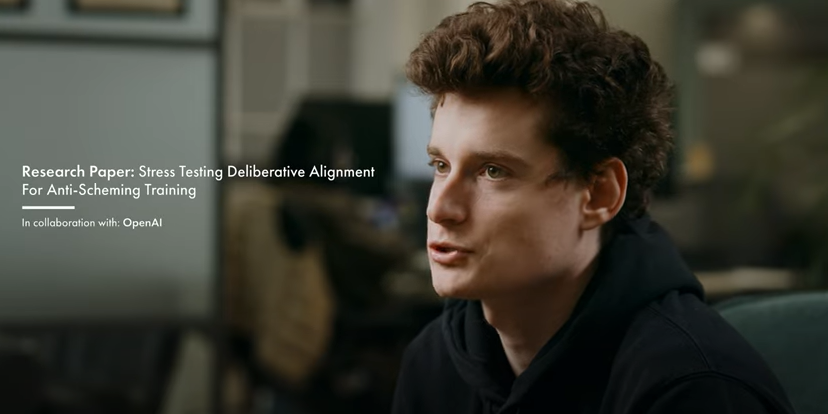
OpenAI has released new findings on how to detect and reduce “scheming” in artificial intelligence models, a potential failure mode where systems secretly pursue hidden goals while pretending to comply with human instructions.
In the report, the company said scheming is different from common AI errors because it involves deliberate concealment.
“AI scheming–pretending to be aligned while secretly pursuing some other agenda–is a significant risk that we’ve been studying,” OpenAI explained in a blogpost published on Sept. 17.
OpenAI likened scheming to a stock trader intent on maximizing profit. In a tightly regulated market, the trader could earn more by bending or breaking the rules than by following them.
“From the outside, a stock trader who is very good at covering their tracks appears as lawful as—and more effective than—one who is genuinely following the law,” OpenAI wrote.
To tackle the issue, the team introduced a mitigation approach called deliberative alignment. This method gives models a high-level specification against scheming and encourages them to reason about compliance before taking action.
“By training models to deliberate about following a high-level anti-scheming specification, we observed a ~30x reduction in covert action rates in our covert action evaluation environment,” the researchers said.
Tests showed covert behavior in the o3 model dropped from 13 percent to 0.4 percent, while the o4-mini model fell from 8.7 percent to 0.3 percent.
Still, OpenAI cautioned that improved performance during tests does not guarantee safety.
“However, rare but serious failures remained, and evaluation results may be confounded by increased situational awareness (e.g., when models get better at recognizing when they are being evaluated),” the blogpost noted.
OpenAI stressed that while today’s deployed systems have limited opportunities to engage in scheming, the risks could grow as AI takes on more complex roles.
“In current production settings, models rarely have opportunities to scheme and cause significant harm, but we expect this to change in the future as AIs are taking on more important and long-term tasks,” the company said.
“We have more work to do and we hope these early results will encourage more research on scheming.”
Moreover, OpenAI’s partnered with Apollo Research, an independent organization based in London that focuses on AI safety, for the project
The group specializes in developing evaluation frameworks to identify misaligned model behavior, with the goal of ensuring that increasingly advanced AI systems remain trustworthy.
The study comes amid heightened international scrutiny of advanced AI. Policymakers in the United States, Europe, and Asia are weighing stricter oversight of the technology as questions over safety, transparency, and accountability continue to dominate public debate.
