


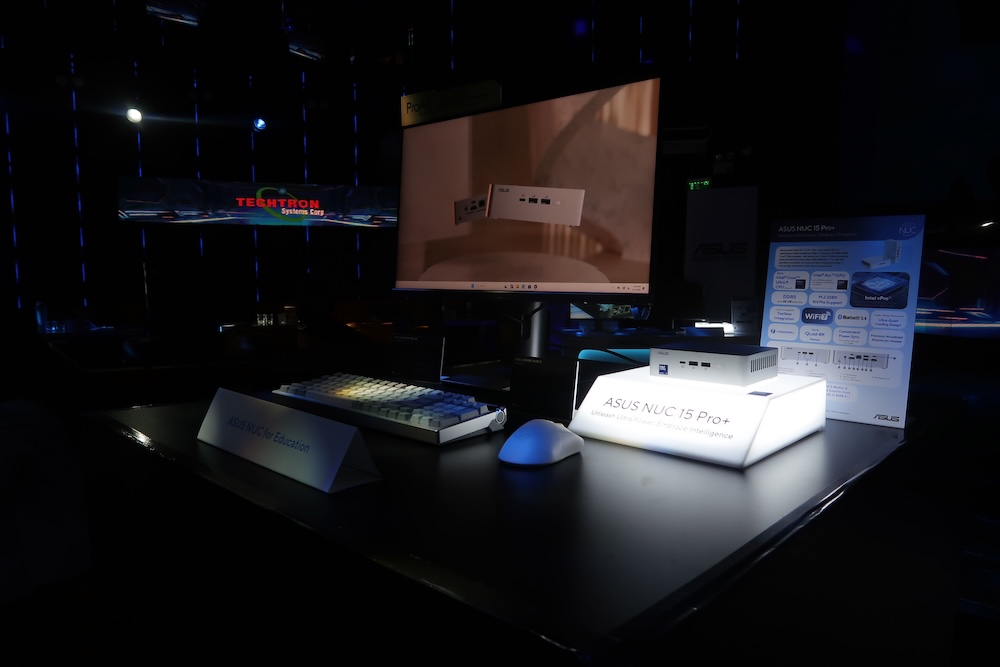
ASUS spotlighted the future of its compact computing platform by unveiling the ASUS NUC 16 Pro, the newest addition to its growing mini-PC lineup. Along with the launch is the announcement of its partnership with Techtron Systems Corp. (Techtron) to expand the reach of ASUS NUC systems in the Philippine market.
Techtron is a local IT solutions provider and technology distributor that will bring ASUS’ compact computing to more businesses, developers, and professionals. Whether deployed in large corporate environments or used as personal systems at home, ASUS wants the NUC platform to be a practical option for users who want powerful computing performance in a small form factor.
ASUS noted that the partnership will help deliver next-generation computing capabilities to Filipino organizations, particularly as AI-powered workloads become more common in professional environments. Techtron will not only distribute ASUS NUC devices but also provide local availability, technical support, and system solutions.
Part of this effort includes bundled packages that pair ASUS NUC mini-PCs with monitors, creating complete workstation setups that simplify purchasing decisions for customers while still delivering strong performance.
The ASUS NUC family was originally pioneered by Intel, giving the platform a strong foundation backed by years of development in compact computing. While the systems are not necessarily the smallest mini-PCs available, ASUS emphasized that it remains significantly smaller than traditional desktops and many competing mini-PCs, without sacrificing performance.
Today, the NUC platform continues to evolve under ASUS’ leadership, supported by dedicated teams focused on optimizing performance, cooling, and reliability within compact designs.
Interestingly mentioned at the event was that many members of the ASUS NUC development team previously worked on Intel’s original NUC program. This continuity is claimed to help maintain the platform’s core design philosophy while benefiting from ASUS’s engineering expertise and hardware ecosystem.
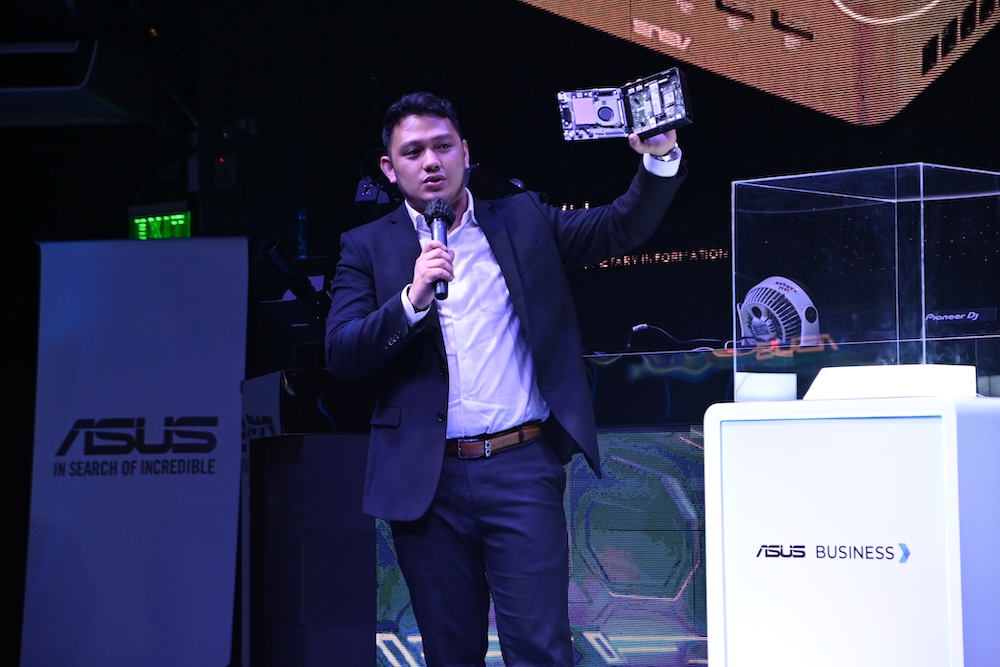
Another one of the highlights of the event was the ASUS NUC 16 Pro, which is making its debut in the Philippine market.
Despite its small form factor, the device is designed to power modern enterprise workloads. It is equipped with Intel Core Ultra 3rd Generation processors, integrated Intel Arc graphics, and 96GB of LPDDR5x memory for AI acceleration while maintaining the energy efficiency needed for a compact system.
It can deliver up to 180 platform TOPS (trillions of operations per second) for AI tasks, enabling it to handle data-intensive workloads and advanced AI applications.
ASUS emphasized that the NUC platform is engineered to deliver powerful computing capabilities while still allowing flexibility for upgrades and expansion. For enterprise environments where space efficiency and performance are both critical, the NUC 16 Pro is posited as a practical solution.
Beyond the NUC 16 Pro, ASUS also showcased its broader NUC portfolio during the Tech @ Night event, demonstrating how the platform is expanding across different use cases and audiences.
The lineup includes:
- NUC 15 Pro: A versatile mini-PC powered by an Intel Core 5/Ultra 5 2nd Gen processor paired with Intel Arc Graphics, designed for professionals, creators, and AI-related workloads.
- NUC 15 Pro+: A higher-performance version of the Pro series with enhanced capabilities. Housing an Intel Core Ultra 9 2nd Gen processor and Intel Arc Graphics.
- ROG NUC: A gaming-focused mini-PC under the Republic of Gamers brand that combines powerful graphics and high-performance components in a compact chassis. Housing an Intel Core Ultra 9 2nd Gen processor and RTX 5060 Laptop GPU with the capability to support NVIDIA DLSS 4.
- NUC 16 Pro: The latest AI-driven system designed for demanding enterprise applications. Housing either an Intel Core Ultra 5, 7, X7, or X9 3rd Gen processor and Intel Arc Graphics.
Together, these systems highlight ASUS’s push to expand the NUC platform beyond traditional office PCs into areas such as gaming, professional workstations, and AI-driven computing.
