


Forget the buzzwords and FOMO. AI is all about accuracy, cost, and flexibility.
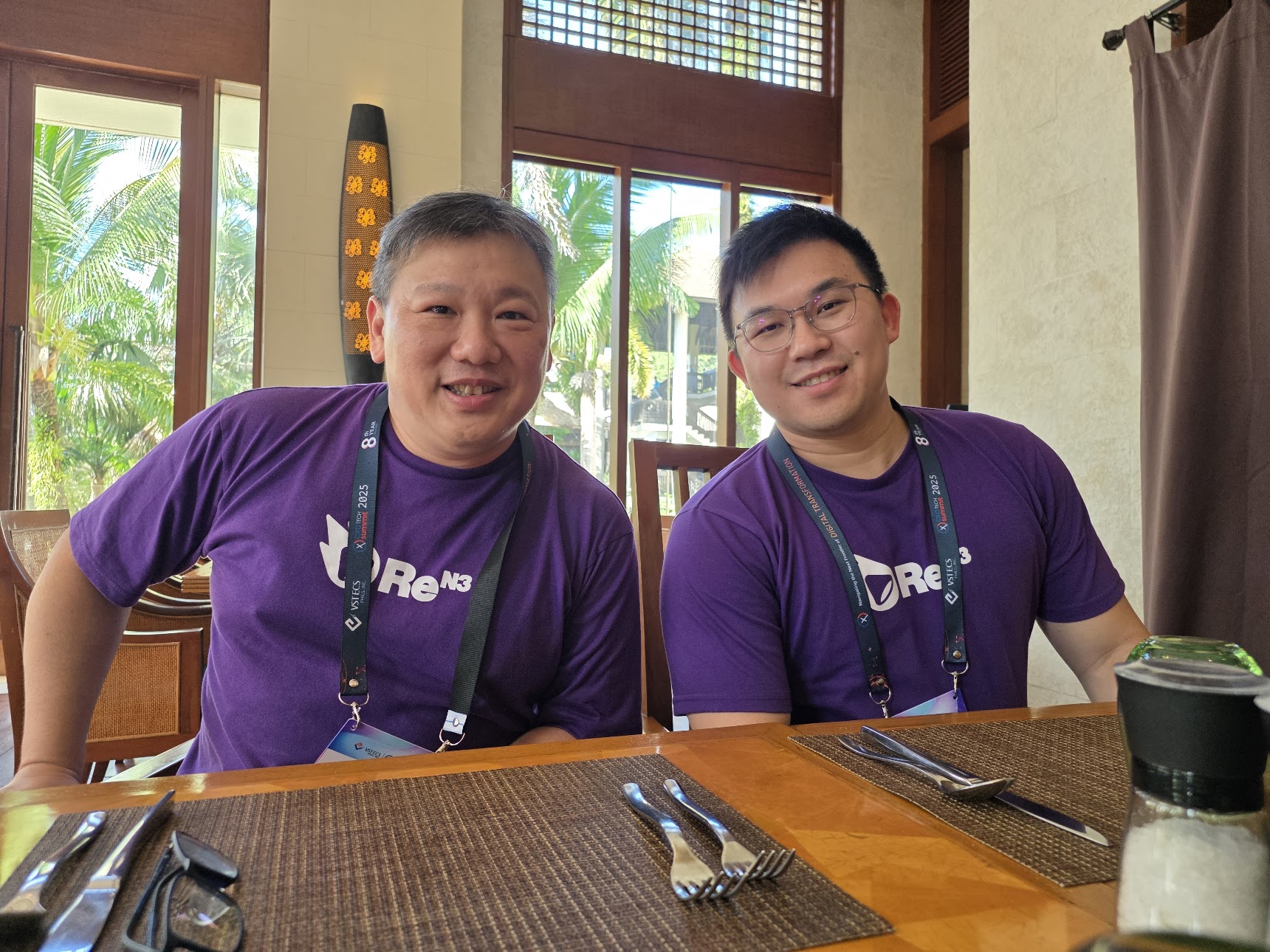
At this year’s VST ECS CXO Summit in Boracay Island, I spent some time talking to Dennis Sze and Lemuel Low, two of the three co-founders of ReN3, an Agentic AI company that I’ve been covering since last year. As a treat, Sze sat me together with Scott Albin, APAC General Manager for Groq. ReN3 has been testing their AI models with Groq for more cost-efficient deployment per token — a critical detail in a world where the cost of compute dictates who can actually afford to use AI at scale.
The cost of AI
The conversation began with a hard truth about AI adoption in the Philippines: electricity is expensive. In fact, we have some of the highest power costs in Southeast Asia – even more expensive than Singapore. That single variable alone makes running high-performance AI workloads here a luxury. The result? Fewer local data centers, slower experimentation, and heavier dependence on cloud providers abroad.
But the real challenge, according to Sze, isn’t convincing companies to use AI — it’s teaching them how to use it responsibly. AI governance has become the new frontier of enterprise readiness. Organizations are learning the hard way that it’s not about plugging in ChatGPT and calling it transformation. It’s about setting realistic expectations for accuracy, managing data privacy, and avoiding “shadow AI,” where well-meaning employees upload confidential data to public models.
Interestingly, the Philippines’ bilingual landscape actually gives modern transcription models an advantage. Sze mentioned that the latest speech-to-text systems now handle English, Filipino, and even regional dialects with impressive accuracy. That makes the country a surprisingly good testing ground for multi-language AI performance.
ReN3’s quiet revolution
ReN3’s approach feels more pragmatic than flashy. Rather than trying to compete head-to-head with the hyperscalers, they focus on what really matters to small and medium enterprises: accuracy, flexibility, and control. Their platform runs multiple Large Language Models (LLMs) — OpenAI, Gemini, Claude, and others — allowing clients to choose the right one for each task. This avoids the trap of vendor lock-in and gives users a way to balance accuracy and cost.

To fight hallucinations, ReN3 uses 11 separate techniques, including cross-model verification — having one AI fact-check another. In practice, this boosts reliability from 60% to 90% right out of the box.
The company’s client list spans manufacturing, casinos, insurance, distribution, and education. In one case, a casino uses AI to monitor social sentiment and adjust engagement strategies. An insurance firm uses it to unify document formats and speed up compliance checks. Even schools are creating 24/7 digital tutors that students can consult without hesitation — a quiet but powerful example of AI augmenting education rather than replacing it.
Groq’s LPU advantage
Then came the Groq conversation. Albin explained that Groq’s Language Processing Unit (LPU) is built for speed and efficiency — a “300-lane superhighway” that can process multiple tasks in parallel. Unlike GPUs, which separate memory and computation, LPUs keep everything on one chip which results to lower power draw, lower cost, and better throughput.
This architecture is key to democratizing AI. “If we can cut energy and compute costs by 60%, that’s when AI becomes accessible to everyone — not just the top 1% of enterprises,” Albin said.
The inevitable AI bubble
Both Sze and Albin agree that delaying AI adoption is a strategic risk. “It’s like insisting on using a paper map when everyone else is on Google Maps,” Sze joked. The race now is not about who can deploy AI, but who can make it sustainable — financially and operationally.
The current AI market feels like the early days of Uber — too many players, too many experiments, and inevitable consolidation ahead. But the companies that survive this phase won’t be the loudest — they’ll be the ones that can make AI practical, affordable, and responsibly managed.
