



The Philippines lost some of its gains in this year’s Global Innovation Index (GII) after improving its position for three consecutive years, with research capacity remaining among the challenges to its innovation performance.
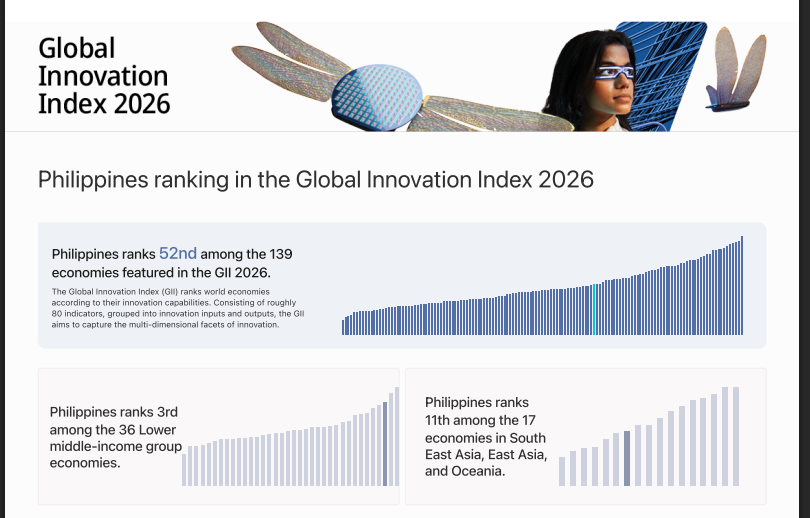
The country ranked 52nd among 139 economies, down from 50th in 2025, according to the World Intellectual Property Organization (WIPO). It placed 53rd in 2024, 56th in 2023 and 59th in 2022.
Despite the decline, the Philippines ranked third among 36 lower middle-income economies and 11th among 17 economies in Southeast Asia, East Asia and Oceania.
The GII uses roughly 80 indicators to measure economies’ innovation capabilities and results, covering areas such as institutions, human capital and research, infrastructure, investment, knowledge creation and creative outputs.
The Philippines’ innovation input ranking fell to 69th from 59th last year, while its innovation output ranking remained at 49th.
Among the seven pillars measured by the index, the Philippines ranked lowest in human capital and research at 100th. The pillar covers education, tertiary education and research and development.
The country also ranked 84th in market sophistication and 64th in infrastructure. Its strongest showing was in knowledge and technology outputs at 37th, followed by business sophistication at 49th and creative outputs at 55th.
The Department of Science and Technology (DOST) said the results underscore the need to strengthen support for local industries, increase private-sector investment in research and development (R&D) and bring more locally developed technologies to the market.
Science Secretary Renato Solidum Jr. said Filipinos have continued to innovate despite limited resources, but greater R&D capacity is needed for the country to compete globally.
Solidum cited the need for increased government investment in R&D, more science and engineering graduates and researchers, and greater private-sector investment in homegrown technologies.
DOST also noted improvements in nine short-term innovation indicators, including scientific publications, R&D investments, connectivity, robotics, electric vehicle adoption, labor productivity and life expectancy.
WIPO nevertheless identified the Philippines as an “innovation overperformer,” meaning its innovation performance remained above expectations relative to its level of economic development.
