


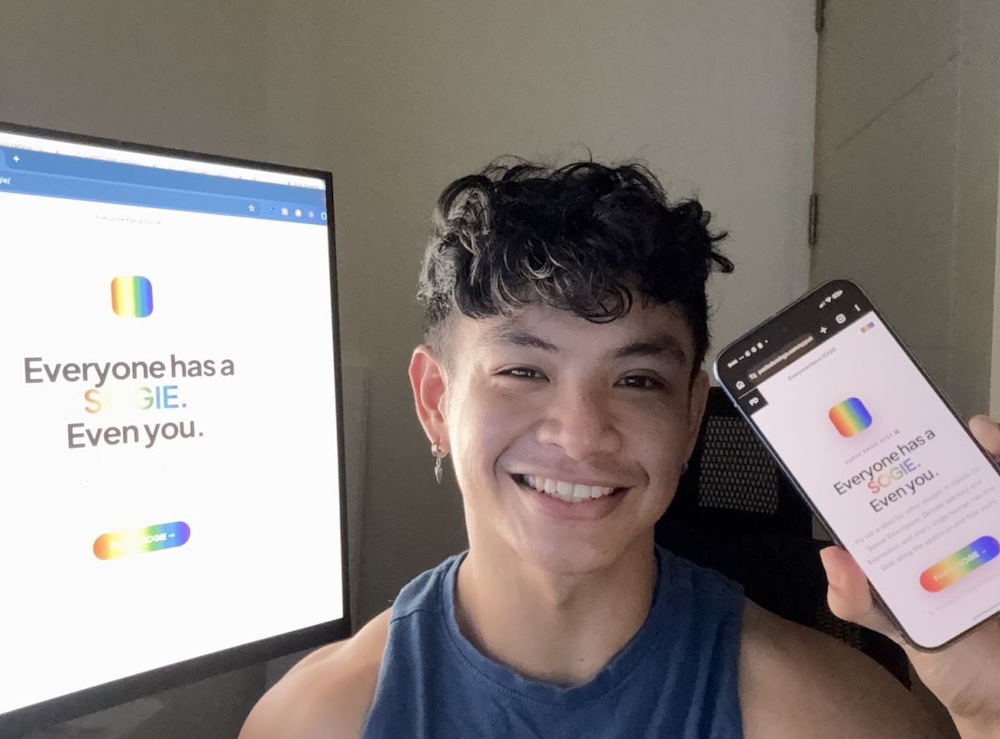
The idea for the SOGIE app started innocently enough.
“A straight guy friend of mine genuinely asked me once, ‘Si [redacted] parang bading pero may girlfriend. Possible pala ’yon?’” recalled 31-year-old software engineer Paul John Payabyab Domingo.
“That innocent question really made me pause. I realized that for many people outside the LGBTQ+ community, SOGIE can be confusing to wrap their heads around,” he added.
SOGIE stands for sexual orientation, gender identity, and expression. Sexual orientation is about who you are attracted to, gender identity is about who you are, and expression is how you present yourself to the world. Still, our patriarchal society, which remains stuck in homophobic slurs and stereotypes, would automatically equate effeminate mannerisms with same-sex attraction, something that the nearly three-decade-old SOGIE bill wanted to correct.
Domingo, a cis gay man himself, said his friend’s remark made him rethink how to approach these conversations in a way that is simple enough for anyone to understand.
“I figured that instead of just trying to explain it on the spot, it would be so much more efficient and less intimidating if the learning was self-paced and interactive. So, I built this app to give people a safe, quiet space to learn,” Domingo said.
Accessible as a web app, those who want to find out what their SOGIE is can simply pull up their browser and go to PaoloDomingo.com/apps/sogie. Domingo said he wanted to make it as barrier-free as possible, with no need to go to an app store or download anything heavy on people’s phones.
Domingo, who appeared as drag artist Sundae Perez in the reality show “Mudrakels,” said that it is incredibly important to know one’s SOGIE “because it gives you the words to finally understand yourself.”
“When you know your SOGIE, you feel seen. It validates your own lived experience. On the flip side, understanding SOGIE helps us respect the people around us. It takes away the fear or confusion of what we don’t know and replaces it with basic human respect and empathy,” he explained.
He also wants to encourage IT professionals like him to use their expertise for the greater cause.
“Especially now, with the mature capabilities of AI and modern web tools, we are more empowered than ever to spread awareness and share good, accurate information within our circle of influence,” he said.
Domingo also echoes the call for the passage of the SOGIE bill in the Philippine Congress.
“Honestly, it hurts deeply. It is incredibly painful and frustrating to watch a bill that simply asks for basic human dignity and protection against discrimination just sit there and languish in Congress year after year. It makes you feel like your safety and your rights are just an afterthought, or worse, something that is up for debate,” he said.
“But as much as it hurts, that pain is exactly why we can’t stop fighting. If the system is slow to protect us, we have to step up and do what we can in our own small ways to educate people and look out for each other.”

