


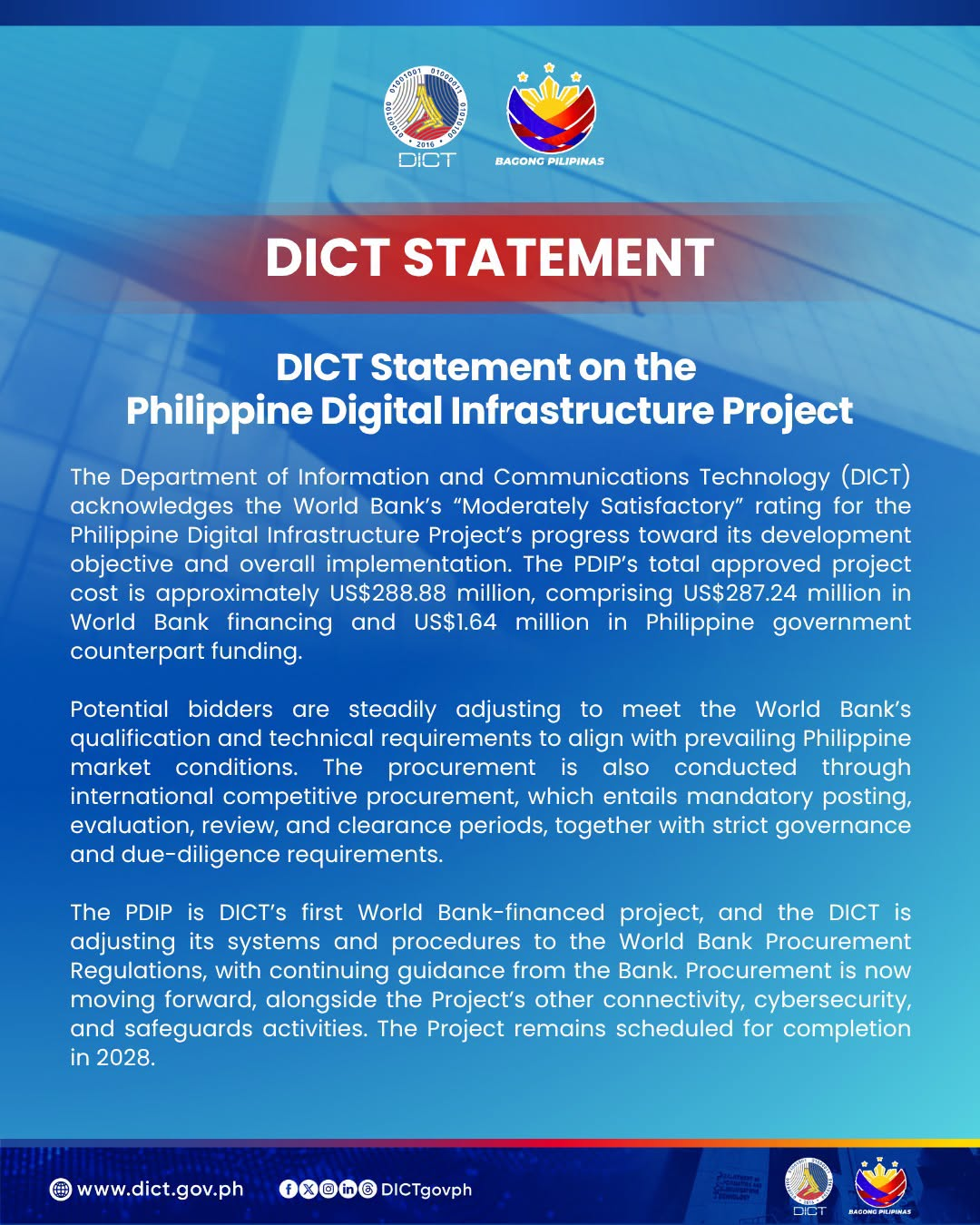
The Department of Information and Communications Technology (DICT) said potential bidders are still adjusting to qualification and technical requirements for the country’s $288.88-million digital infrastructure project, as procurement delays continue to slow its implementation.
The DICT issued the statement after the World Bank rated the implementation of the Philippine Digital Infrastructure Project (PDIP) as “moderately satisfactory,” reflecting delays in the project’s procurement process.
The PDIP seeks to expand the country’s fiber infrastructure and improve broadband connectivity, particularly in underserved areas. It includes the expansion of the National Fiber Backbone, as well as middle-mile and last-mile connectivity infrastructure.
The project is expected to improve broadband access for more than 20 million Filipinos by 2028.
Based on the official website of the International Trade Administration of the United States of America, procurement difficulties have been particularly evident in the National Fiber Backbone Phases 4 and 5. An initial bidding round failed, prompting the DICT to conduct a rebid. The rebid also failed after the lone bidder did not meet the required qualification standards.
The DICT said potential bidders are now “steadily adjusting” to the World Bank’s qualification and technical requirements, which the agency said are being aligned with prevailing conditions in the Philippine market.
The department also noted that the procurement is being conducted through international competitive procurement, which involves mandatory posting, evaluation, review and clearance processes, as well as strict governance and due diligence requirements.
The PDIP is the DICT’s first World Bank-financed project, requiring the agency to adjust its systems and procedures to comply with the lender’s procurement regulations.
The project has $287.24 million in World Bank financing and $1.64 million in Philippine government counterpart funding, for a total approved cost of $288.88 million.
Despite the procurement delays, the DICT said implementation is moving forward and the project remains targeted for completion in 2028.
