


The Philippines is aiming to become a major regional player in the digital world, with the government setting an ambitious target of 1.5 gigawatts (GW) of data center capacity by 2028. This goal, established under the National Digital Connectivity Plan (NDCP), marks a huge leap for the country’s infrastructure.
However, industry experts warn that hitting this target will require more than just building warehouses; it will require a total overhaul of how the country manages staggering amounts of power and heat.
The nation’s live data center capacity currently sits at roughly 200 megawatts (MW). To hit the 1.5 GW mark, the industry must close a massive gap that is already testing the limits of an aging electrical grid.
One of the primary hurdles is no longer just space, but electricity. As data centers expand, securing a stable connection to the national grid has become a significant bottleneck.
Because of potential power shortages and a shaky electrical grid, data centers are no longer just waiting for a connection, they are becoming their own power plants. The industry is seeing a trend where operators build their own “microgrids” right next to their server rooms.
This includes everything from “gas plugs” to “renewable alternative energy,” with some companies even planning to build “their own solar parks beside their data center.” The goal is to solve the “grid problem” and ensure that these massive AI systems stay online 24/7.
Even if the power is secured, a second crisis is brewing inside the server racks: heat. Traditional data centers in the Philippines were built to handle “cloud” tasks, like hosting websites or emails. But artificial intelligence (AI) requires massive amounts of computing power, leading to what experts call “extreme density.” A single rack of AI equipment now produces as much heat as an entire room of old servers.
“Those of them are existing data centers and we are not designed for AI loads,” said Nico Echavarria, the newly appointed country head of Vertiv Philippines, a provider of critical digital infrastructure and continuity solutions, during a media briefing. “So there will be complexities into how to deploy the AI chips or AI solutions into existing premises.”
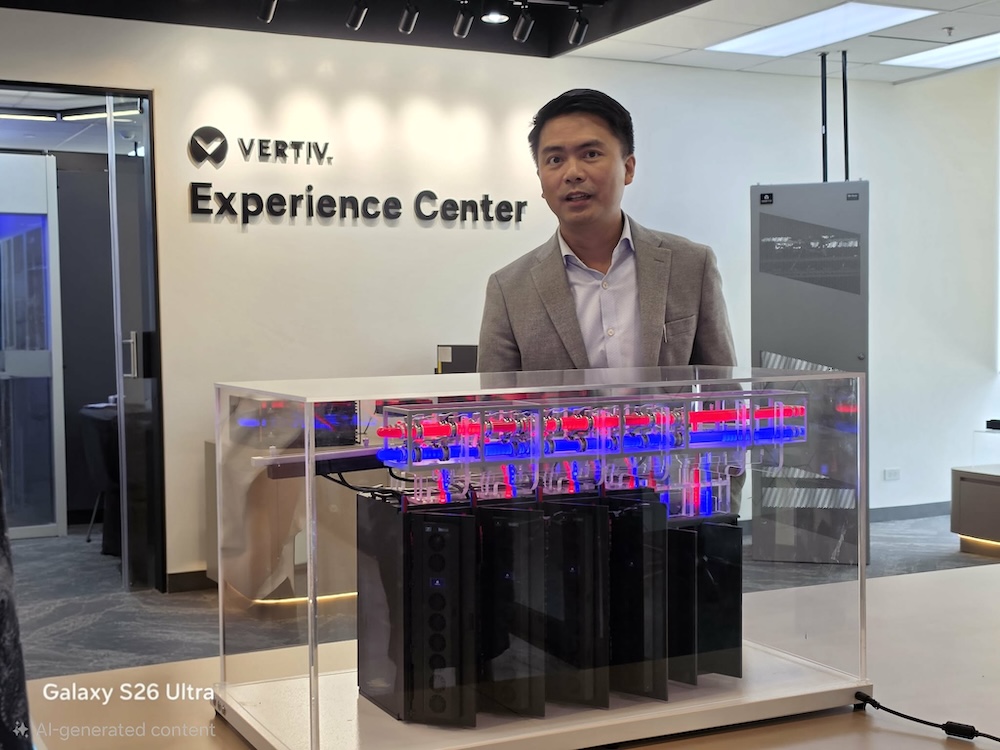
Because air conditioning can no longer keep up with the intense heat of AI chips, the industry is pivoting toward liquid cooling. New Philippine data centers will need to circulate specialized liquids directly through the hardware.
This transition is critical because “thermal shock,” or sudden changes in temperature, can damage expensive AI equipment.
“You would need liquid cooling to basically take out the heat more efficiently from the chip,” Echavarria said.
According to Vertiv, the industry is shifting away from slow, custom-built projects that take years to finish. Instead, companies are turning to “prefabricated” or modular solutions, or like building blocks that come pre-installed with power and cooling. These can be deployed in a fraction of the time, allowing the Philippines to hit its 2028 goals without waiting years for construction to finish.
