


Filipinos are no longer strangers to artificial intelligence.
As of May 2026, 81% of Filipino consumers had already interacted with an AI-powered service or tool. ChatGPT summaries, rewritten emails, generated images, research, transcription, and AI quietly working in the background of everyday apps have become normal fast.
Businesses are adopting AI too, but using it is one thing. Actually getting value out of it is another.
The last few years have been filled with nonstop talk of integrating AI into workflows, automating systems, and giving employees new tools. But after all that adoption, what has it actually done for the business?
During the launch of Boston Consulting Group’s Philippine AI Maturity Report, one of the bigger questions was why Philippine companies were still struggling to turn AI adoption into stronger business results. Were they leaning too heavily on efficiency and cost-cutting instead of using AI to create new revenue streams, services, and growth?
The answer was surprisingly neither.
“Most companies are actually focused on neither. I think they are focused on setting it up,” BCG Partner Lance Katigbak said during a group interview.
That puts many Philippine companies in an awkward middle ground. The tools are being introduced, employees are being trained, and AI is slowly finding its way into everyday work, but much of that effort is still focused on getting people to use it in the first place.
BCG breaks that progression down into three plays: Deploy, Reshape, and Invent.
Deploy is what most of us already recognize. Give employees AI and let them use it for transcription, research, editing, summaries, and other everyday tasks.
Useful? Definitely.
Transformative? Not really.
BCG’s report states many companies are still stuck here.
Reshape goes further. Instead of using AI to make one part of an existing process faster, companies start redesigning the process itself around what AI can do.
Then there is Invent, where AI becomes a way to create entirely new products, services, and revenue streams.
Reaching that stage remains relatively rare in the current Philippine business climate, and part of the reason comes down to something much less exciting than innovation. Cost.
During the panel, business leaders including Roscoe Pineda, CIO of Ayala Land, and Dodong Pineda, Chief Data and Analytics Officer of EastWest Bank, pointed to one practical reason why: AI is not automatically cheap just because it is software.
As Roscoe put it, “Humans are still cheaper than AI here.”
When dissecting this statement in the Philippine setting, it makes sense for businesses because labor remains relatively inexpensive, while many AI platforms, cloud services, and models are still being bought at global prices. The savings companies expect from automation do not always translate the same way here.
That makes simply replacing people with AI a much less obvious equation than it might be in the United States.
It was also a point raised during the panel: if a human employee is already affordable, understands the context of the business, and can learn, paying continuously for expensive AI usage does not automatically produce better margins.
The solution-making and discussions should be less on replacing people and more about making the people you already have capable of doing more.
Give them better tools to work with. Train more employees to use the systems properly. And instead of discarding experienced workers, use that experience to improve how AI is applied in the first place. The workforce can help shape the models and workflows, while the technology helps them work faster, make better decisions, and take on higher-value tasks.
As it stands, the Philippines has some catching up to do.
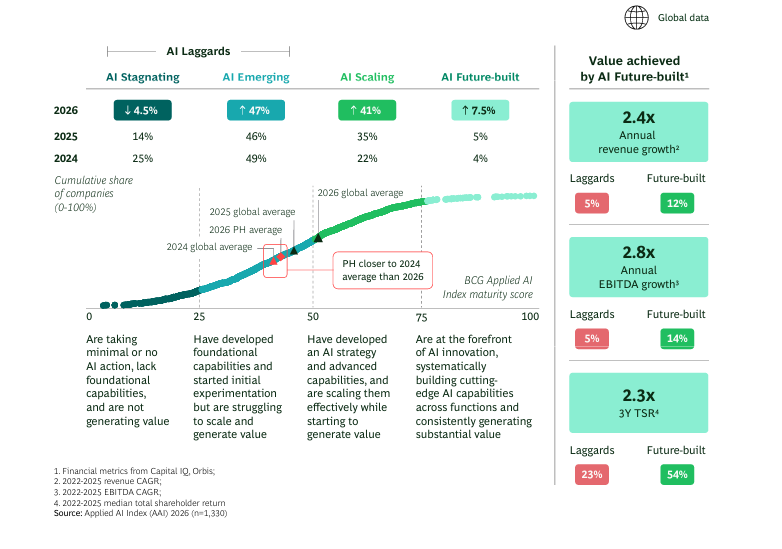
BCG places the country roughly two years behind the global AI maturity curve. Philippine companies have started building technology and data foundations, but those investments have not consistently translated into stronger products, customer experiences, and business results.
Around 60% of surveyed Philippine companies were still classified as either AI Stagnating or AI Emerging in 2026, with none considered Future-built. By 2029, more than half expect to reach that highest category.
That is a very big jump from where we are now.
And for the Philippines, being average at AI may not be enough.
Not to ring alarm bells or hit the panic button, but our economy has spent decades selling one very specific advantage to the world: skilled, English-speaking labor at a comparatively affordable cost.
BCG estimates Philippine labor costs are around 70% below the APAC average and 80% below the global average. The IT-BPM sector alone generated roughly $40 billion in export revenue and supported around 1.9 million workers.
We have more at stake because service is one of the things we sell.
Realistically, the bigger danger is everyone else learning to use AI to deliver the same services better, faster, or cheaper than us within the next few years. Other countries could find ways to replace parts of what we currently offer while we are still celebrating that everyone in the office finally has access to a chatbot.
BCG lays out two possible paths for the Philippines.
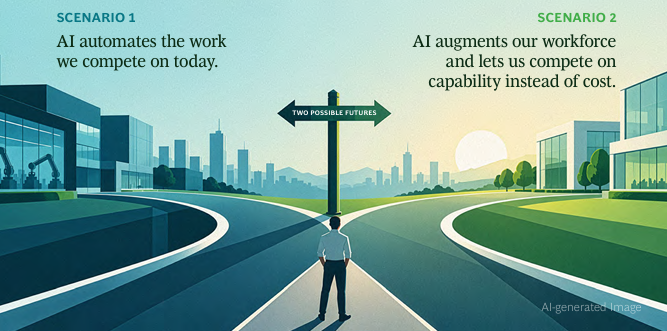
In one, AI automates the work we already compete on. The same output requires fewer people, and over time the labor-cost advantage that made outsourcing to the Philippines attractive starts losing its edge.
In the other, AI augments Filipino workers. Repetitive work gets pushed toward machines while people move toward judgment, problem-solving, customer relationships, and eventually entirely new products and services.
The report suggests we are currently closer to the first path, which actually might be the problem.
Buying AI platforms is easy. You can count licenses, training sessions, prompts, and hours supposedly saved, but none of those automatically mean the business became better.
After adoption, what did it really give you?
If AI saves someone two hours, what happens to those two hours? Are they used for more productive things?
Once everything has been shortened, automated, and thinned out as much as possible, what comes next?
For a service economy like ours, AI cannot only be another efficiency tool.
We are the efficiency tool.
The opportunity is figuring out how AI can make Filipino workers and businesses more valuable than they were before it arrived.
None of us has a crystal ball. Maybe our service-based economy adapts just fine. Maybe AI never replaces as much work as people fear.
But if the one advantage we have spent decades building starts becoming less valuable, waiting to find out seems like a very expensive and detrimental gamble to our people and economy.
Adoption cannot be the final step.
At some point, it has to become augmentation and innovation.
