


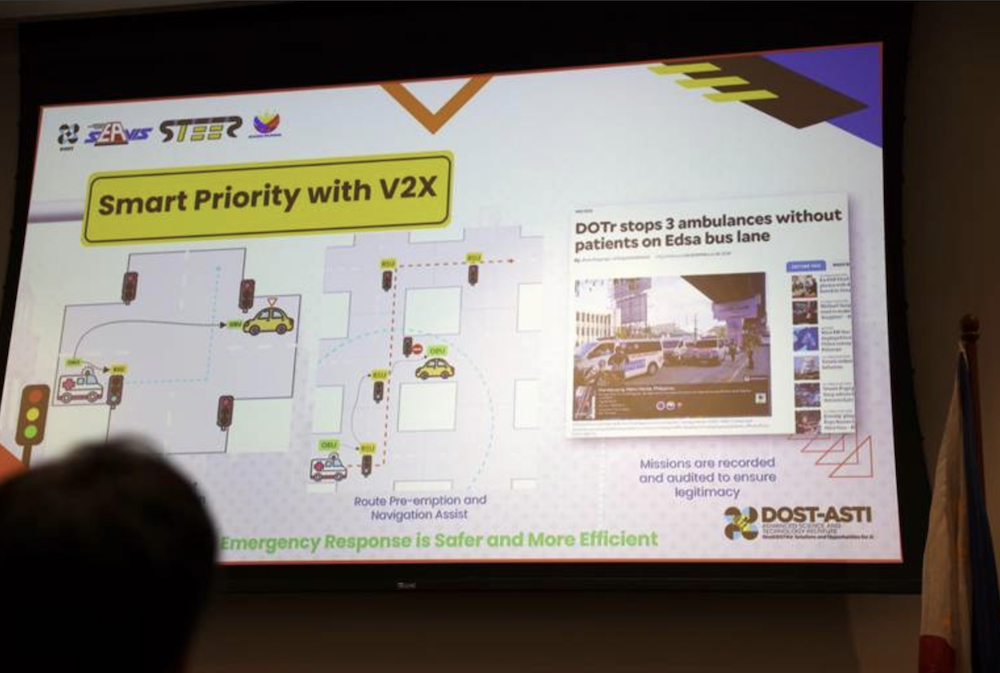
The Department of Science and Technology (DOST) is working on a new digital traffic system designed to help emergency vehicles move faster and avoid getting stuck in heavy traffic.
The system is called the Swift Emergency Response Vehicle Integration System with Smart Traffic and Electronic Enforcer on the Road, or sERVis-STEER. It is being developed by the DOST-Advanced Science and Technology Institute (DOST-ASTI).
The goal is to solve a common problem in cities and towns: ambulances, fire trucks, and other emergency vehicles often get delayed because of traffic jams, especially during urgent situations.
According to Miguel Asido of DOST-ASTI, the project uses a technology called Vehicle-to-Everything (V2X), which allows vehicles and traffic systems to communicate wirelessly.
Emergency vehicles will have special onboard devices that talk to traffic lights and roadside equipment. When an ambulance or fire truck is approaching, the system can automatically change traffic lights to green to clear the way.
This setup is called automated route preemption, where intersections “give way” in real time so emergency vehicles can pass more quickly and safely.
Right now, traffic enforcers usually have to manually change traffic lights or open lanes to let emergency vehicles pass. These methods can work, but they are not always smooth or consistent. They can also confuse drivers and sometimes create safety risks on the road.
The system also tries to fix another issue: there is currently limited tracking of emergency vehicles. This makes it hard to confirm if some trips are real emergencies, and in some cases, sirens or priority lanes have been misused.
The project also includes a central online platform called the Emergency Response Information Exchange Server Platform. This connects hospitals, dispatch centers, traffic agencies like the Metropolitan Manila Development Authority, and field responders.
It allows real-time tracking of emergency trips, scheduling, and checking of records to help make sure only valid emergency missions get priority on the road.
“We need a full partnership of our local government units, partner agencies, and all of you to bring the same sense of urgency that our emergency responders bring to the road every day,” said DOST Secretary Renato Solidum, Jr. in a video message.. DOST has always believed that science is most meaningful when it reaches the people who need it most.”
He added that sERVis-STEER is not just a research project.
DOST said the project is not only meant to speed up emergency response and reduce deaths, but also to help build a wider system for smart traffic management in the country. This supports long-term plans for smarter and more sustainable cities.
