


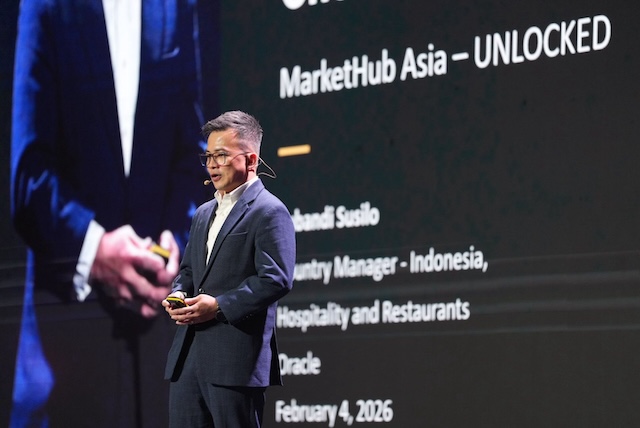
BALI, INDONESIA – Artificial intelligence (AI) is set to become an invisible but critical part of hotel operations, according to an executive from enterprise software firm Oracle.
Speaking at Markethub Asia 2026, a hospitality industry conference organized by HBX Group, Subandi Susilo of Oracle said the next phase of AI adoption in hospitality will be defined less by visible features and more by how deeply the technology is integrated into booking, pricing, housekeeping, and guest service platforms.
Rather than being deployed as standalone tools, he said AI works best when integrated into existing workflows that hotel staff already use.
“AI cannot be the bolt-on feature. It has to be embedded across the platform—filled with trusted data and delivered with strong security, privacy and of course measurable business outcome,” Susilo said.
He cited industry data showing that AI-led booking and discovery channels are growing by more than 100% year on year as travelers rely more heavily on AI-driven recommendations instead of traditional search.
Personalization, he said, has shifted from being optional to expected, with more than half of millennials and Gen Z travelers preferring AI-generated recommendations.
Hotels are also expected to increase their use of AI for revenue management, particularly in pricing and inventory optimization.
Susilo said more than 70% of hotels are projected to adopt AI-driven pricing tools within the next 18 months, allowing room rates to be adjusted in real-time based on demand.
Beyond pricing, AI is being used to automate routine guest requests, coordinate housekeeping and maintenance tasks, and support marketing and data analytics.
Virtual assistants are increasingly handling common inquiries to free hotel staff of other tasks so they can focus more on higher-value interactions, he said.
However, Susilo cautioned hotels against deploying AI without clear business purpose, saying that investments should focus on high-impact use cases such as improved booking conversions, lower operational costs, and stronger guest loyalty.
Susilo also emphasized the importance of data security, privacy, and governance, particularly as guest data fuels more personalized and automated services.
The annual conference gathered hospitality leaders and technology providers in Bali, Indonesia to discuss how data, cloud computing, and AI are reshaping the travel and tourism industry.
It is organized by HBX Group, a global travel technology company, and focuses on emerging trends affecting travel platforms and tourism stakeholders.
