



IBM is no stranger to reinvention.
The company started out on June 16, 1911, through a merger of four others. This brought the technologies of the dial recorder, the electric tabulating machine, the bundy clock, and the computing scale together under a single roof.
At that time, all that was cutting edge.
Like those new-fangled horseless carriage.
When Thomas J. Watson, Sr. took the reins in 1915, he brought a culture of sales and customer service to match the arsenal of commercial scales, industrial time recorders, meat and cheese slicers, tabulators, and punch cards.
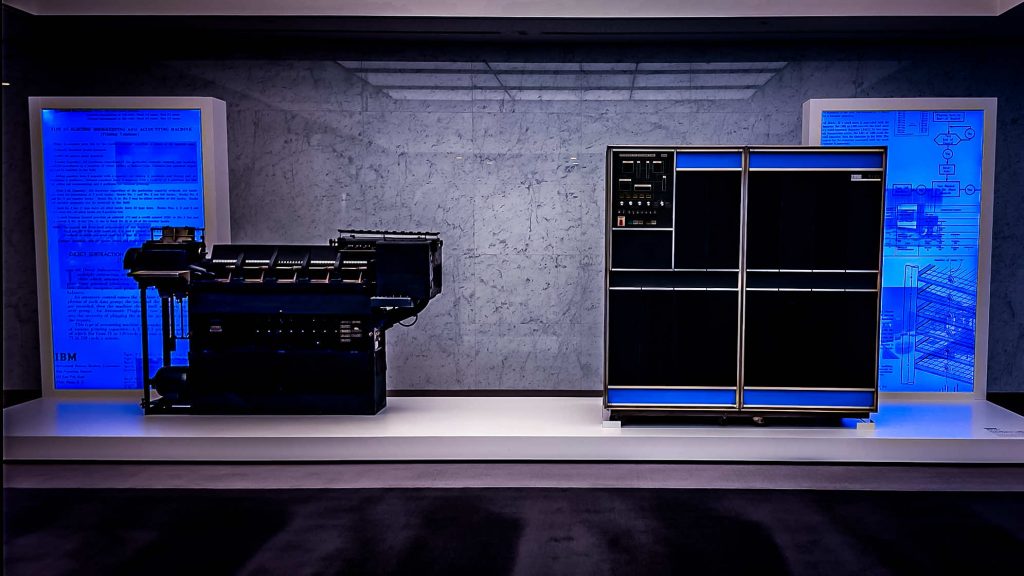
When the US needed a census done, Watson snapped the opportunity up. He reinvented an existing tabulator into an army of machines able to handle demographic data.
These devices, primitive as they may seem today, changed the world as it was known. All of a sudden, any business or government could get a handle on vast amounts of data, faster and more efficiently than any previous manual process used.
Thanks to this agile dynamism Watson brought in, IBM rocketed to the forefront of global business computing solutions.
From here, they pioneered many industry firsts. The first hard drive, the first magnetic stripe card, the first practical person, computer, and the host of other projects, many of which eventually became spin-off IBM companies.
Interestingly, they showcased the first example of an artificial intelligence in 1956, with a program that played checkers, and could learn from its mistakes.
It was during this golden era that IBM reinvented itself into anything and everything computing.
This is when IBM became a household name. The world changed under their watch, and computing became accessible to all.
But things weren’t always wine and roses for Big Blue. Their tabulating machines saw heavy use on both sides of the Atlantic during World War II, allowing the Nazis to conduct census on their populations, and then aiding the Allies in decoding enemy cryptography.
During the 90s, they posted a US$8 billion loss. The company did a lot of soul-searching, and eventually decided to focus on their roots: business computing, research, and development.
They sold off all unrelated assets, including their personal computing business.
They launched the Watson AI – named for Mr. Watson who initially transformed the business – in 2006. This is one of the longest running AI developments in the world, spanning over 18 years.
One of the critical moves that allowed them to continue supporting business computing requirements was the acquisition of Red Hat Linux in 2016. This is one of the most stable Linux server operating platforms, with deep developer and community support.
In an unprecedented move, IBM committed to keeping the operating system open source. This shift in corporate intellectual property policy from proprietary to community, coupled with the platform’s reliability, opened the door for IBM to power a significant global percentage of both on-premise and cloud business servers.
They likewise committed to building the next generation of processors. In an October 6, 2022 press release, IBM committed to a US$20 billion investment in the United States’ Hudson River Valley area for the development of various initiatives, including quantum computing.
This latest reinvention has once again put IBM on the finest point of the cutting edge.
If this were any other company, a pivot like this would have represented a radical step forward.
For one as storied as IBM, however, this is a quantum leap back to its core.
IBM has reset their sights on that spirit of innovation, that same daring which allowed them to reinvent how business itself is done.
Where will this bring us?
IBM sees a collaborative future, with quantum computing complementing classical digital machines, community co-building with corporations, and artificial intelligence augmenting our own.
We don’t know if this future will come to pass.
But we do know that when IBM reinvents itself, they tend to change the world.