



By Dean Solano
My first voyage with Assassin’s Creed IV: Black Flag was not in 2013. I played it years later on my PS4, after I had already fallen in love with Assassin’s Creed Origins and Assassin’s Creed Odyssey. Those were the games that pushed me deeper into Assassin’s Creed and eventually made me curious about the older titles that helped build the franchise into what it was.
That probably affected the way I saw Black Flag from the very beginning. I loved the game. The writing was great, Edward Kenway quickly became one of my favorite protagonists in the series, and sailing across the Caribbean while my crew sang sea shanties gave me something that neither Origins nor Odyssey could quite replicate. But coming from those newer games, I could also immediately see its age. Character models, lighting, environments, animations, and even some of the movement looked and felt noticeably older to my eyes.
And yet, while playing it, I remember thinking about how incredible Black Flag could look with modern graphics. Imagine those turquoise waters with current-generation lighting. Imagine sailing directly into a storm with modern weather effects. Imagine Havana, Nassau, and Kingston with the environmental detail we had started seeing in the newer Assassin’s Creed games. At the time, that was little more than wishful thinking. I enjoyed the game we had and never seriously expected Ubisoft to rebuild it.
Now, with Assassin’s Creed Black Flag Resynced, that version of the game I used to imagine is actually here.
The Caribbean I remember, but better
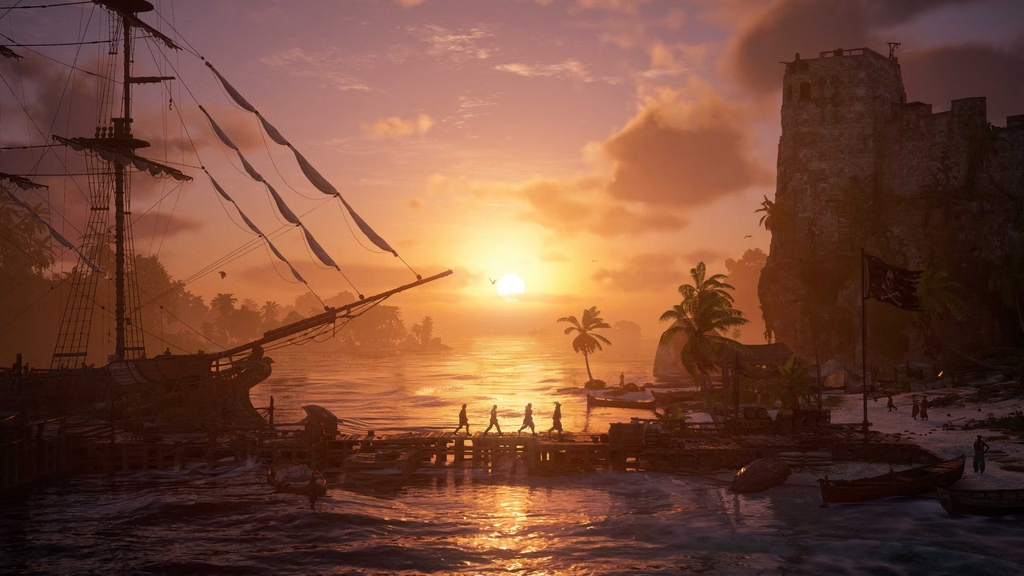
This is easily where Resynced made its strongest first impression on me. Black Flag has never looked this good. Ubisoft rebuilt the game using the latest version of the Anvil engine, bringing ray tracing, a new dynamic weather system, denser environments, and a more seamless Caribbean to Edward Kenway’s adventure.
For someone who already thought about what a modern Black Flag might look like years ago, simply sailing around can be enough to justify stopping for a moment and looking around. The water is beautiful. Storms feel more violent. Tropical environments are denser, and settlements feel much more alive. Seeing the Jackdaw cutting through the ocean as the weather changes around it makes the pirate fantasy stronger than it has ever been.
And that matters because the Caribbean is not just a backdrop in Black Flag. It is part of the reason the game works. So much of my memory of the original is not tied to individual missions, but to the moments between them: sailing toward an island, spotting another ship in the distance, hearing the crew begin another shanty, or deciding that whatever mission I was supposed to be doing could wait because there was something interesting on the horizon.
The remake understands that. In fact, Ubisoft has added new dynamic weather, additional environmental destruction, new shanties, and other content around the world rather than simply increasing the resolution of the original assets.
It also creates a funny feeling when I compare it with my memories of playing on PS4. I remember Black Flag looking better than it actually does now when I go back to footage of the original. Maybe that is just what nostalgia does. Resynced almost looks like the version my memory had already created for me.
Being a pirate is still the best part
Pretty graphics would mean very little if the heart of Black Flag had disappeared. Thankfully, the reason I loved the game in the first place is still here.
Edward Kenway is still Edward Kenway.
That sounds obvious, but his story is incredibly important to why Black Flag has remained one of my favorite Assassin’s Creed games. Edward does not begin his journey as a dedicated Assassin fighting for some grand ideal. He wants wealth, freedom, and a better life. His selfishness gets him into increasingly larger problems, and much of the game is about watching that ambition collide with the people around him.
It is one of the best-written character journeys in the franchise, and all these years later, it still works.
Then there is the Jackdaw. Sailing, attacking enemy ships, weakening them with cannon fire, pulling alongside them, and boarding their decks is still ridiculously satisfying. There is something about Black Flag’s naval loop that feels almost timeless. Ubisoft has changed plenty around it, but the fantasy is still incredibly simple: there is a valuable ship over there, and I want what is on it.
That simplicity is part of the magic.
Resynced also expands Edward’s adventure rather than only recreating it. Ubisoft added new storylines involving familiar characters such as Blackbeard and Stede Bonnet, along with three new officers who join Edward during the main narrative. The Guardian similarly praised the new officer missions and the remake’s greater focus on activities that actually reinforce the fantasy of being a pirate.
And perhaps that is why returning to Black Flag feels so easy. I came for Assassin’s Creed when I first played it. I stayed because I wanted to be a pirate.
Old Black Flag, modern Assassin’s Creed
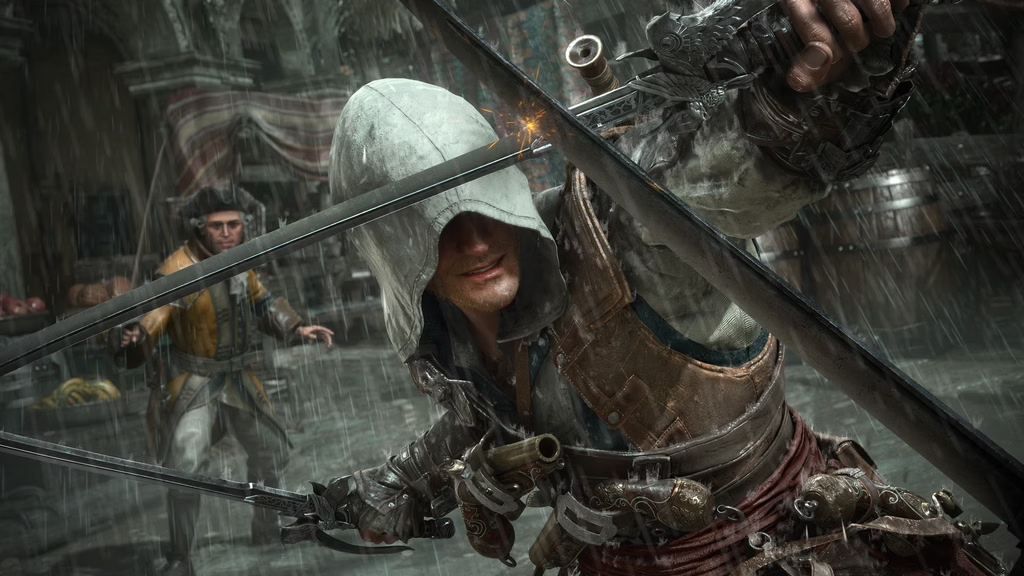
The modernization goes much further than the graphics. Combat has been reworked, several frustrating elements from the original have been reconsidered, and Resynced is generally much more willing to remove friction from a game originally designed more than a decade ago. Ubisoft has even removed the old mandatory tailing missions, while combat now offers more options and new mechanics.
And coming from Origins and Odyssey before I ever played the original Black Flag, I am probably more open to that than some longtime fans.
The old combat could look fantastic, especially when Edward chained together brutal finishers, but it was never particularly difficult. There were times when fighting an entire group of soldiers felt more like triggering a sequence of cinematic executions than actually surviving a dangerous fight. Resynced attempts to give those encounters more depth.
For me, that modernization generally works. I do not need Black Flag to preserve every movement animation or combat interaction exactly as it existed in 2013. I already experienced that version. What I want from a remake is the opportunity to return to the same world without constantly being reminded of the limitations of the era it came from.
But this is also where Resynced becomes more complicated.
Modern does not automatically mean better.
But some treasure was left behind
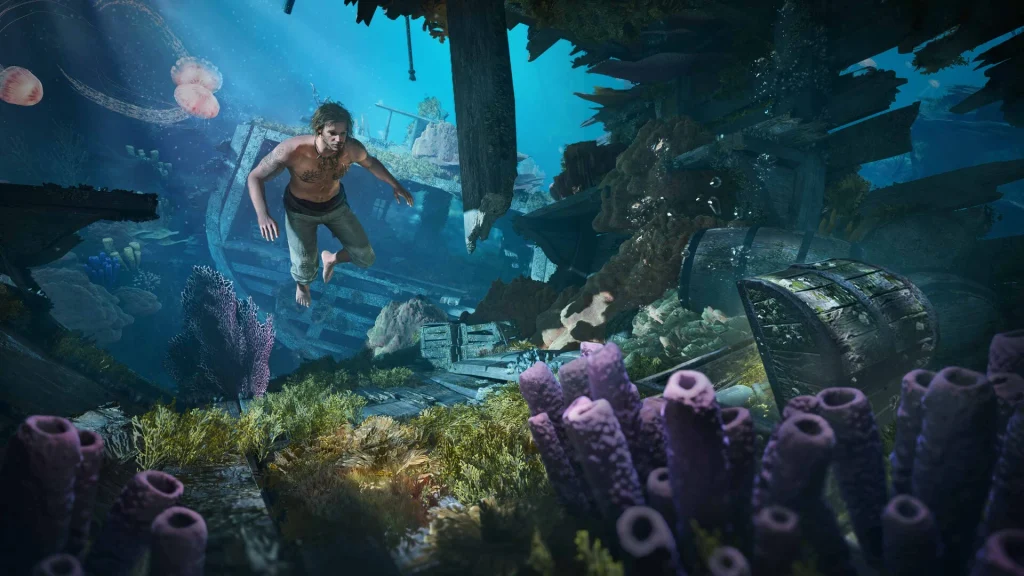
As much as I wanted a modern-looking Black Flag, I understand why some players have come away from Resynced feeling that something was lost.
The original combat was easy, but it had style. Edward could tear through a group of enemies with animations that made him look like the most dangerous man in the Caribbean. The newer system may offer greater mechanical depth, but that does not mean every change carries the same personality. PC Gamer’s review made a similar criticism, arguing that the remake is well made but loses some of what made the original distinctive in the process of modernizing it.
Then there is the removal of the modern-day Abstergo sections.
I know these sequences were divisive even when Black Flag originally released. Plenty of players simply wanted to get back into the Animus and continue being Edward. In Resynced, those playable Abstergo interludes are gone, with much of that material reduced to logs rather than fully playable sequences. The change undeniably keeps the focus on the Caribbean, but it also removes a piece of what connected Black Flag to the larger Assassin’s Creed universe. Both PC Gamer and TechRadar singled this out as one of the remake’s more questionable decisions.
I think that criticism is fair. If the purpose of a remake is to take an old idea and see what can be done with today’s technology, I would have rather seen Ubisoft remake and improve those sections than simply remove them.
There is also no multiplayer. PC Gamer lists Resynced as a single-player-only release, meaning the competitive multiplayer from the original Black Flag does not return. For players who spent a lot of time with that side of the original, this cannot really be considered a complete replacement.
And that is the uncomfortable thing about remakes. Every time you sand away something old and awkward, there is a chance you also sand away something that gave the original character.
Resynced is smoother. It is prettier. In several areas, I think it is simply more enjoyable to play. But I would not tell someone that the 2013 version suddenly has no reason to exist.
Verdict
When I first played Black Flag on PS4 after Origins and Odyssey, I loved it despite immediately noticing how much older it looked. The story, Edward Kenway, the Jackdaw, the sea shanties, and the freedom of the Caribbean were strong enough that the graphics ultimately did not matter.
But I would be lying if I said I never wished it looked like the Assassin’s Creed games I had played before it.
That is why Assassin’s Creed Black Flag Resynced feels special to me. It is not simply another remake of a game I enjoyed. In a strange way, it is a version of Black Flag I had already imagined years before anybody told me it would actually exist.
Not every modernization is an improvement. The missing Abstergo sections leave a noticeable hole in the wider Assassin’s Creed story. Multiplayer being absent means part of the original package has been left behind. And while I generally enjoy the updated mechanics, I understand why some longtime fans prefer the weight and personality of the old combat.
But the things that made me love Black Flag survived.
Edward is still one of the franchise’s best protagonists. The Jackdaw still feels like home. The shanties still make long voyages feel too short. And now the Caribbean finally looks as beautiful as I once imagined it could.
Maybe Black Flag Resynced does not completely replace the game I remember. Maybe it was never supposed to.
But when the sails drop, the crew starts singing, the Caribbean opens up in front of me, and another Spanish ship appears on the horizon, I stop comparing 2013 and 2026.
I just want to be a pirate again.
