

Artificial intelligence (AI) has already made its way into Philippine enterprises, though not always in ways that are easy to see. It shows up in small efficiencies and the acceleration of everyday tasks, which has been enough for various local teams to signal progress. But once companies begin to ask more of it, or once AI is expected to plug into workflows, the limits become clearer. Teams now believe AI should start running into the architecture of the business itself.
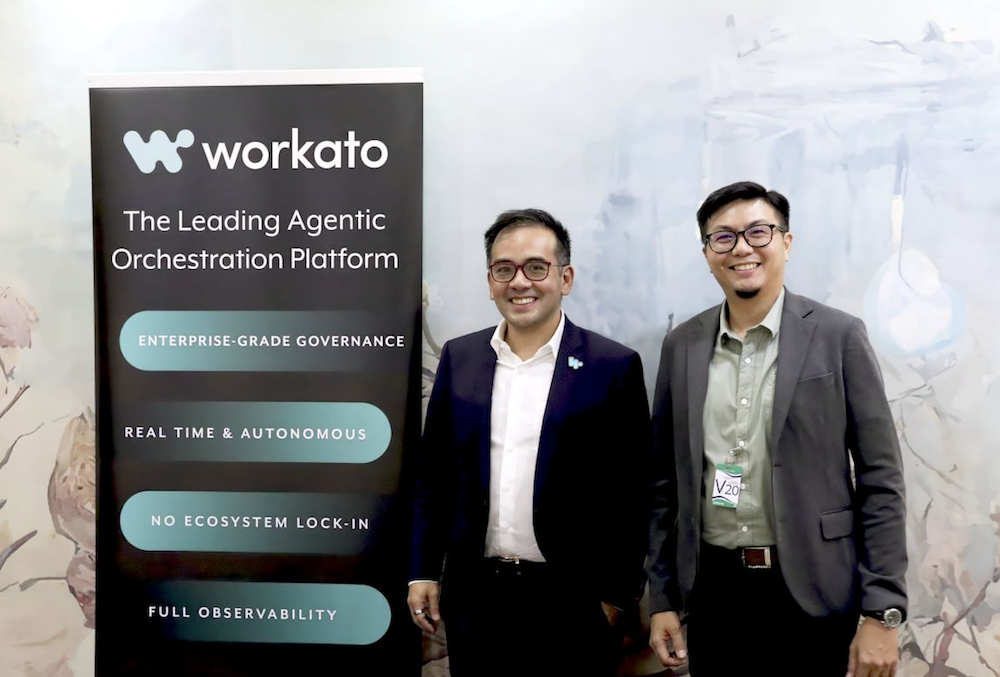
“AI transformation does not start with a model. It starts with connectivity,” said Tyrone Borromeo, managing director of Workato Philippines, at the official launch of the agentic orchestration platform in the country.
Disconnected systems
Most enterprises already have access to capable AI tools. What they do not have, at least not yet, is a clean way for those tools to interact with the systems that hold their data and drive their operations. Systems are added over time, often in response to immediate needs, until what remains is a layered environment of platforms that were never designed to fully align. ERP (enterprise resource planning) systems sit alongside HR (human resources) tools, customer platforms, internal databases, and spreadsheets that have outlived multiple upgrades.
On their own, each system works. Together, they slow things down.
This becomes most visible when companies try to introduce something that needs to move across all of them. AI depends on access, not just to one dataset but to many, and to how those datasets relate to each other. Without that, it operates in (buzzword!) “fragmented systems,” offering outputs that feel detached from the actual flow of the business.
Workato has spent much of its history in that middle layer, focusing on integration and automation. Its platform connects systems and allows workflows to run across them by making those systems interoperable. That same layer is now being used to support AI, giving it a way to move through the organization rather than sit on top of it.
In the Philippines, these challenges tend to converge quickly. Companies are not hesitant when it comes to trying new technologies. If anything, the pace of experimentation is faster than expected, driven by teams that are comfortable working across digital tools and willing to test what works.
Borromeo, who spent more than two decades in the United States before returning last year, noted that willingness to experiment as one of the market’s strengths.
“There’s a lot of innovation happening in Filipino companies,” he said. “The challenge is getting beyond pilots and making them deliver measurable business results.”
The accuracy problem
Even with access — and it becomes harder to ignore the closer AI gets to real operations — results are not always consistent.
Borromeo described an internal example, where AI was used to evaluate customer support tickets. The task seemed straightforward: Feed the ticket into the system, assess the interaction, assign a grade. What came back, though, varied more than expected. The same ticket could produce different outcomes depending on how and when it was processed, as if the system were interpreting each request slightly differently every time.
What changed the outcome was completely the structure around it, not just the model itself. Workato’s role here has been to extend its orchestration capabilities into AI, allowing companies to define how these systems behave within workflows rather than relying on variability at the edges. Because once the AI was connected to internal systems and given clearer rules (service levels, severity categories, expected response standards), the outputs began to stabilize. It was working within a defined set of conditions that reflected how the business worked.
The question of trust
When asked to circle back to something more fundamental than consistency or capability, Borromeo turned to “trust.” Workato has positioned this as part of its infrastructure layer, building controls into the same platform that handles integration and automation, so that AI does not sit outside governance but is shaped by it.
For CIOs and technology leaders, giving AI access to core systems introduces questions that are difficult to sidestep: What exactly can it see, what actions can it take, how are those actions monitored, and who is accountable for them. Without clear answers, AI remains confined to low-risk environments that may be useful but very limited.
If AI is going to operate across systems, it needs to do so within boundaries that are visible and enforceable. The system has to be something organizations can audit, not just observe.
Bridging instead of replacing
For some companies, the response has been to rethink how modernization happens. Rather than replacing systems outright, the focus has shifted toward connecting them in ways that make the experience more seamless.
At Jollibee Foods Corp., expansion brought with it a range of systems across different regions and brands. Standardizing everything would have required significant time and resources, with little immediate return. Instead, the company focused on how employees interacted with those systems day to day with the help of Workato.
Procurement workflows, for example, were integrated and surfaced through Microsoft Teams, allowing approvals to happen within a single interface. Behind the scenes, multiple platforms were still involved, but from the user’s perspective, the process felt unified.
What emerges from these efforts is a more deliberate path to AI adoption, where systems are connected first to ensure that automated workflows are sensible (not just running for the sake of automation).
Workato often describes this progression as an AI flywheel, where each layer reinforces the next. Integration supports automation, and automation creates better outcomes. Those outcomes make AI more effective, which in turn drives further integration.
For many Philippine enterprises, this kind of approach aligns more closely with how change happens. Almost incrementally, and often in response to immediate needs rather than long-term redesigns.
