


AI has been talked about almost exclusively in terms of utility since it began seeping into people’s everyday habit, second only to its role in reshaping the entire workforce.
But when AI moves into spaces that feel personal and carry a sense of comfort, or routine, it adds an emotional dimension to pure function and we see AI for what it can really be: a companion.
Global brand Samsung is a pioneering AI innovator, but mostly a believer of connectivity – a positioning that runs on the art of harmony rather than futurism. AI has not perfected memories or gets clunky when we feed it too much prompt, but we see its strength in personalization, in the small ways a device begins to respond to how you, particularly, live. Until it feels less like technology and more like part of the environment and something you count on when you want “your world” at ease.
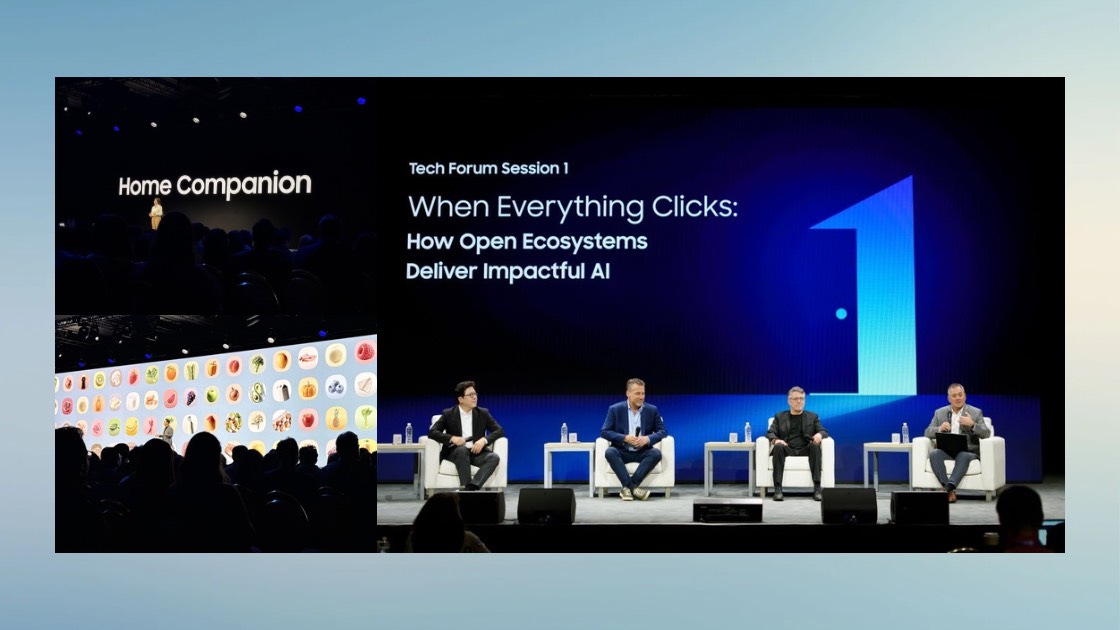
That idea sat at the center of Samsung’s CES 2026 First Look during the first Tech Forum panel held at The Wynn in Las Vegas. Titled “When Everything Clicks: How Open Ecosystems Deliver Impactful AI,” the session talked about how interoperability pushes AI to settle into daily life, as discussed by experts Yoonho Choi, President and Chair of the Home Connectivity Alliance and Head of Strategic Alliances at Samsung Electronics, Michael Wolf, founder and editor-in-chief of The Spoon; and Jed Usich, Senior Vice President of Strategic Growth Solutions at HSB.
The open tech behind ‘Home Companion’
You move through your home without thinking much about it. You adjust the lighting, rearrange furniture, clean up, make small changes over time until the space reflects how you live. Slowly, the design of a home begins to mirror what’s on your mind.
But, if a home can take shape around your habits, can the things that clean it, cool it, cook in it, and protect it begin to understand those habits too?
Samsung’s answer was the idea of AI as a “Home Companion” that folds itself into routines. This layer has been the missing piece of the “smart home” conversation for more than a decade. Connectivity and sensors have existed for years. What hasn’t quite worked is making those systems feel worth keeping because it simply does not resonate on an emotional level.
Choi calculates the metric of success by how a system can save money, time, or effort in a way people can actually feel. If it doesn’t, it stays a demo. AI only becomes part of everyday life when its value is tangible enough to notice without being reminded.
The kitchen is a clear example. It’s one of the few spaces in the home where routines are consistent and unavoidable. Wolf noted that roughly a third of household food ends up wasted, “a statistic that carries both financial weight and growing anxiety as prices continue to rise. “ The promise isn’t governing. AI won’t tell you what to eat. Instead, through connected appliances and platforms like SmartThings, it helps surface patterns: what you overbuy, what spoils too often, and where small adjustments can reduce waste. In the same way smart thermostats once changed how people thought about energy use, Samsung suggested AI could do the same for food gently and over time.
Protection and prevention
Usich spoke from the insurance perspective, where connected homes can prevent damages like water leaks and appliance failures that cost homeowners money and insurers significant losses. AI alerts you when something has gone wrong, but recognizes warning signs early enough to stop problems before they escalate.
What makes this possible, Choi explained, is that many appliances already generate the signals needed to predict risk. The challenge is translating that information into something meaningful without being intrusive. The data involved is non-personal, limited to how a machine is behaving, and shared only as insights with trusted partners – such as Samsung’s collaboration with Hartford Steam Boiler (HSB) – who can act on it responsibly.
Privacy became one of the longest threads of the discussion. That none of this works without trust. Consent has to be explicit. Data collection has to be minimal. Benefits have to be clear. Samsung’s stance is shaped by the reality that appliances stay in homes for years, sometimes decades. “A breach of trust doesn’t just affect a product cycle, but also affects a long-term relationship.”
Openness and interoperability
No home belongs to a single brand. Most kitchens, even the best-equipped ones, are a mix of ecosystems. Without shared standards and collaboration across manufacturers, and service providers, the value of AI stays fragmented. The panel framed openness as a practical necessity if AI is meant to work in the background rather than constantly asking for attention.
It was clear that no one was claiming the smart home had been solved. What felt different was the focus and how Samsung has moved away from what AI can do and toward what it should do to reduce friction and provide a sense of ease inside spaces that already matter to people.
