


Artificial intelligence continues to attract strong interest among Philippine businesses, but turning that enthusiasm into real business impact remains a challenge. While many organizations are experimenting with AI, very few are seeing returns at scale.
That disconnect is not unique to the Philippines.
A recent MIT study found that 95 percent of generative AI pilots fail to move beyond the trial stage. For David Irecki, Chief Technology Officer for APJ at Boomi, the reason is clear: companies are rushing into AI without fixing their data foundations first.
“There’s no shortage of ambition,” Irecki said. “But many organizations are building on shaky ground.”
According to him, disconnected systems, poor data quality, and weak governance are the biggest reasons AI initiatives stall before delivering measurable ROI.
Optimism is high, execution is harder
In the Asia-Pacific region, the Philippines is showing strong intent when it comes to AI adoption.
While markets like Singapore and Australia are further along, Irecki noted that the Philippines is moving in the right direction, supported by national digitalization efforts and growing private-sector confidence.
That confidence is reflected in PwC’s 2025 CEO Survey, which found that 75 percent of Filipino CEOs are confident about integrating AI into their core processes.
Still, optimism alone is not enough.
“The real challenge now is execution,” Irecki said, pointing to fragmented data practices and uneven governance as persistent roadblocks that slow progress across industries.
The real bottleneck: data that can’t flow
When asked what Philippine businesses struggle with most, Irecki pointed to what he calls the “data maze”. Siloed systems, manual processes, and information locked in spreadsheets or paper records.
“The hardest part is getting data to actually move,” he explained.
Without data liquidity, AI systems lack the context they need to generate useful insights. Clean, current, and connected data is especially difficult to maintain in sectors or regions where digitization is still uneven.
AI, he stressed, does not work in isolation. It needs a complete picture of how systems and processes connect. Without that, even advanced models underperform.
What should come before AI
For organizations just starting out, Irecki’s advice is to resist the urge to experiment too quickly. Before investing in AI tools or pilots, companies need a clear data strategy that prioritizes integrity, governance, and accountability.
Too often, businesses launch multiple AI initiatives without proper guardrails, resulting in scattered projects that fail to deliver long-term value. Simplifying legacy systems and ensuring consistent data flows across the organization are critical early steps.
Governance also plays a central role. Leaders need visibility into where AI is used, what data it relies on, and who is responsible for its outcomes.
Why scaling breaks down
Even when pilots succeed, scaling them across the enterprise introduces new risks.
Boomi’s research shows that 70 percent of technology leaders deploy AI agents before putting governance frameworks in place. Only 2 percent say their AI systems are fully accountable, while most admit they lack control.
Without oversight, AI initiatives can quickly become fragmented and opaque. Irecki emphasized that organizations should treat AI as part of a broader ecosystem. One that includes people, processes, and policies rather than as a standalone technology experiment.
Starting small, proving value
To build confidence, Irecki recommends focusing on practical, low-effort use cases that show clear returns early. Automating repetitive tasks such as invoice matching, claims processing, or anomaly detection can demonstrate measurable ROI within months.
Finance, healthcare, and education are particularly well positioned for these early wins, as they already work with large volumes of structured and semi-structured data. These successes help build trust internally and lay the groundwork for more ambitious AI projects later on.
Bringing order before innovation
Boomi’s integration platform is designed to address these challenges by connecting legacy systems and modern applications into a unified data environment. By automating data movement and enforcing governance, organizations can support AI adoption in a more sustainable way.
At the core of Irecki’s message is trust. Reliable data, transparent processes, and clear accountability are what allow AI to move from experimentation to real impact.
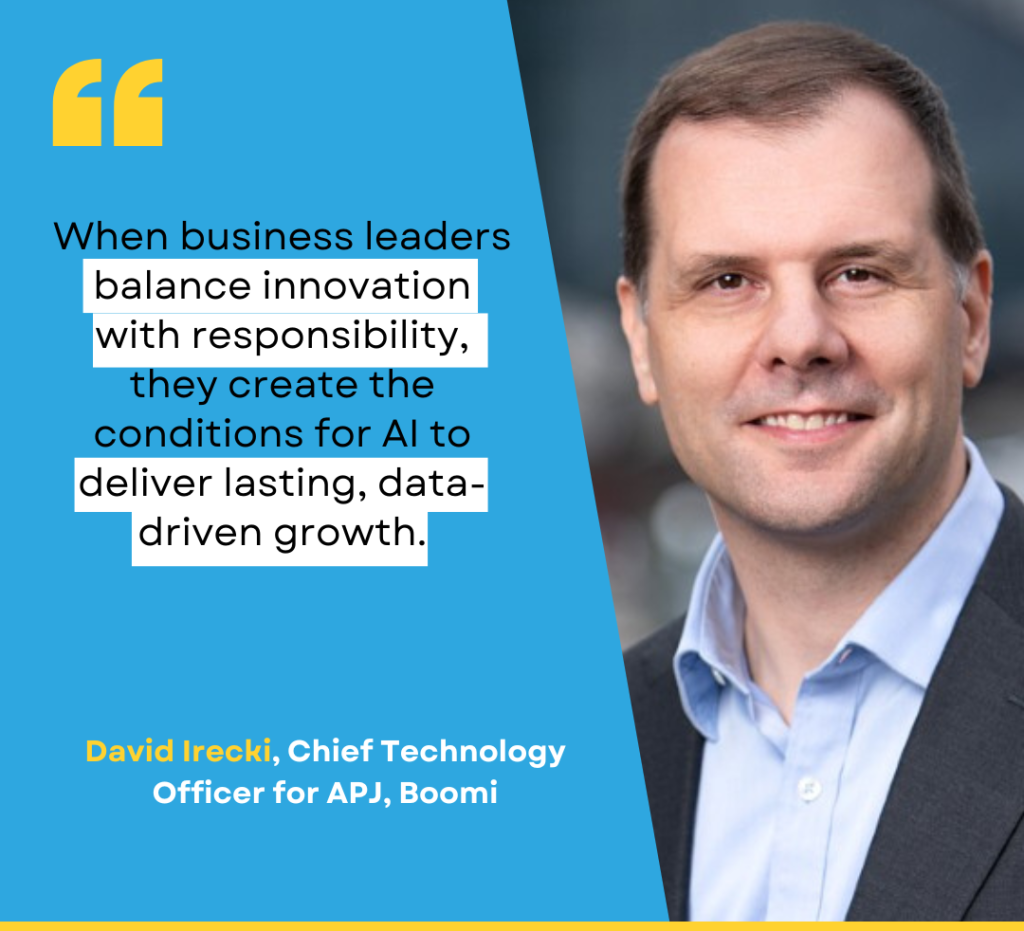
“When business leaders balance innovation with responsibility,” he said, “they create the conditions for AI to deliver lasting, data-driven growth.”