


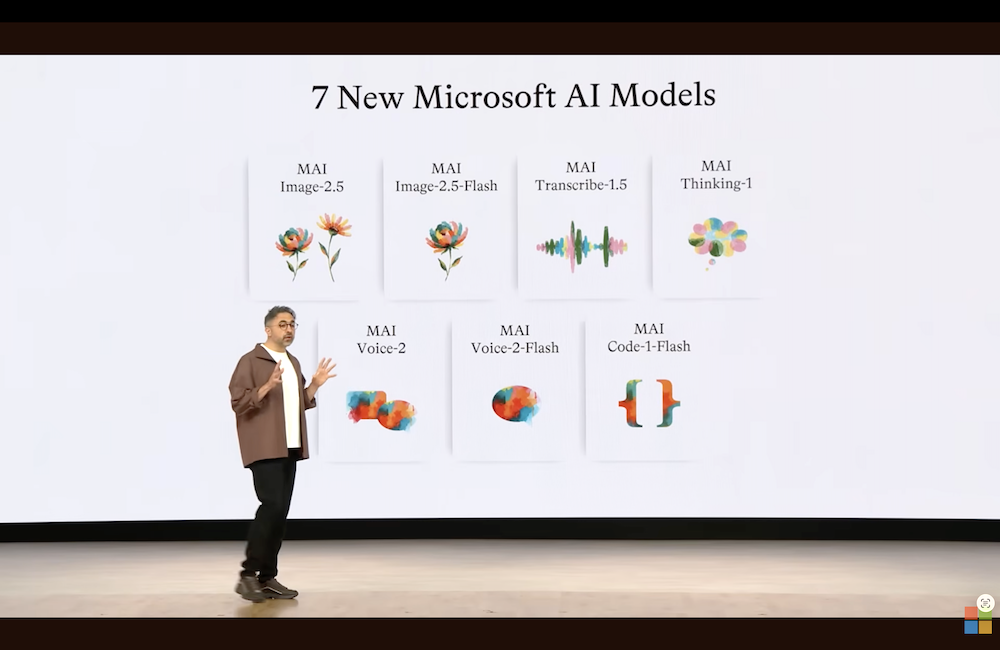
Microsoft has introduced seven new artificial intelligence (AI) models, expanding its efforts to build more tools for everyday work, coding, and business use.
The announcement came during its annual Build conference, where the company also said it is setting up a new “superintelligence lab” that will build more advanced AI systems in the future.
Microsoft said the computing power used to train cutting-edge AI models has already grown significantly and could increase another 1,000 times in the next three years. The company believes this will lead to much more powerful AI systems and wider use across industries.
The new AI models cover different tasks like thinking and reasoning, coding, image creation, speech-to-text, and voice generation.
One of the key models, MAI-Thinking-1, is designed to solve harder problems in areas like coding and math. This model performs at the level of top models in its class.
For developers, MAI-Code-1-Flash is built to help write and fix code inside tools like GitHub Copilot and Visual Studio Code. It is designed to be fast and more cost-efficient.
The company also launched MAI-Image-2.5 for generating and editing images, MAI Transcribe-1.5 for turning speech into text in 43 languages, and MAI-Voice-2 for creating natural-sounding voices that can even copy a speaker’s voice from a short sample.
Microsoft is also introducing a new idea called “Frontier Tuning,” which allows companies to train AI models using their own work data and processes instead of relying only on general training data.
This approach can make AI more useful for specific companies while also using less computing power.
Microsoft is also working with Mayo Clinic to build a specialized AI system for healthcare. The model will use the clinic’s medical expertise and anonymized patient data to help with tasks like diagnosis and treatment planning. It will first be used inside Mayo Clinic, and later could be made available to other hospitals through Microsoft’s platform.
Microsoft says its long-term goal is what it calls “Humanist Superintelligence,” which means AI systems designed to support people rather than replace them. It maintains, though, that people must always remain in control.
