


If Google’s Search bar could talk, it would probably know more about Gen Z’s hopes and fears than most people. Their search histories might contain some of their most profound dreams, but what’s interesting is how practical those dreams often look through a typical Gen Z lens.
I’ve had friends talk about searching how to start a dropshipping business or even build an events agency from scratch. At Search Day in Manila, Google argued that the future of Search is being built around those very questions.
To illustrate how Search already plays a role in young people’s lives, Google brought together seven Filipino Gen Z creators whose stories reflected the platform’s everyday impact. The panel included entrepreneur and computer science student Lowell Rubino, who uses Search to balance school and business; financial literacy creator Kate Reig, who relies on it to track market developments; writer and culture creator Andrea Panaligan, who used Search to find her way into publishing; film and theater creator Kyla Polintan, who once Googled how to write a movie review; education creator Michiko Bernas, who searched for better ways to learn; career creator Matthew Rotea, who researches workplace and interview trends; and figure skater Kat Lacanilao, whose search for opportunities eventually took her to the Winter Olympics. For many of them, major life decisions began with a simple query typed into a search bar.
Alongside Gen Z creators and youth leaders, Google showcased how Search is evolving from traditional keyword searches into a more conversational, AI-powered assistant. Through product demonstrations, the company highlighted new features designed to help users explore information in a way that feels more like chatting with a “bestie.”
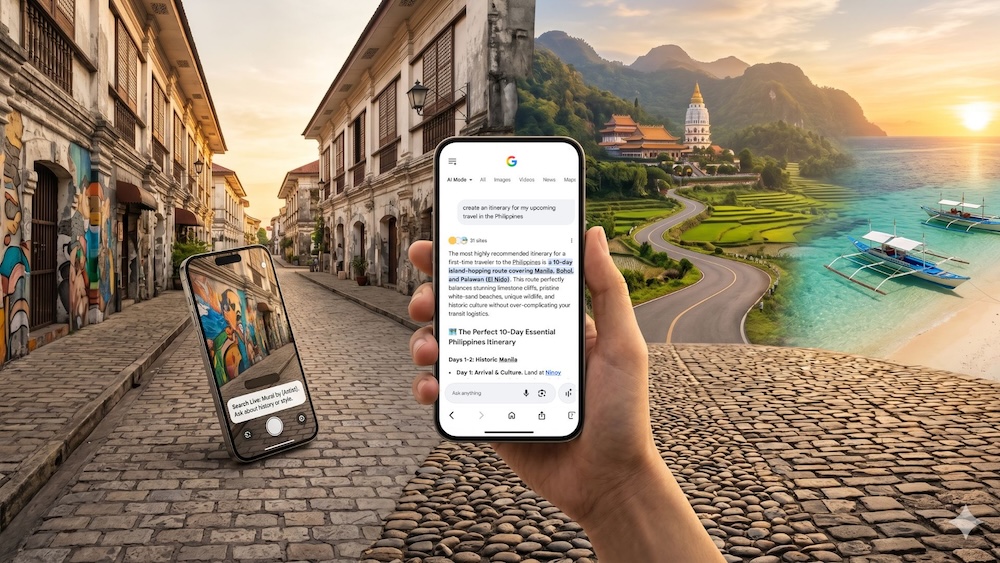
Travel emerged as one of the clearest examples of how Google sees these AI-powered capabilities fitting into everyday life. In AI Mode, users can ask more nuanced questions and receive synthesized responses tailored to their needs. During demonstrations, Google showed how AI Mode can help users plan trips, build itineraries, discover restaurants, compare options, and gather information without having to jump between multiple tabs and websites. Instead of searching for individual pieces of information, users can ask complex questions in natural language and refine the conversation as they go.
Google also showcased Search Live, a feature that turns a smartphone camera into an interactive search tool. By pointing a camera at an object or even a building, users can ask questions in real time and receive contextual information about what they’re seeing. The feature is designed to make discovery more intuitive, whether someone is exploring a new city or simply trying to identify something unfamiliar.
While the event offered a glimpse into Google’s latest AI-powered tools, it was also a reminder that the questions people ask online often reveal what they’re curious about, and, eventually, what they’re trying to become.
